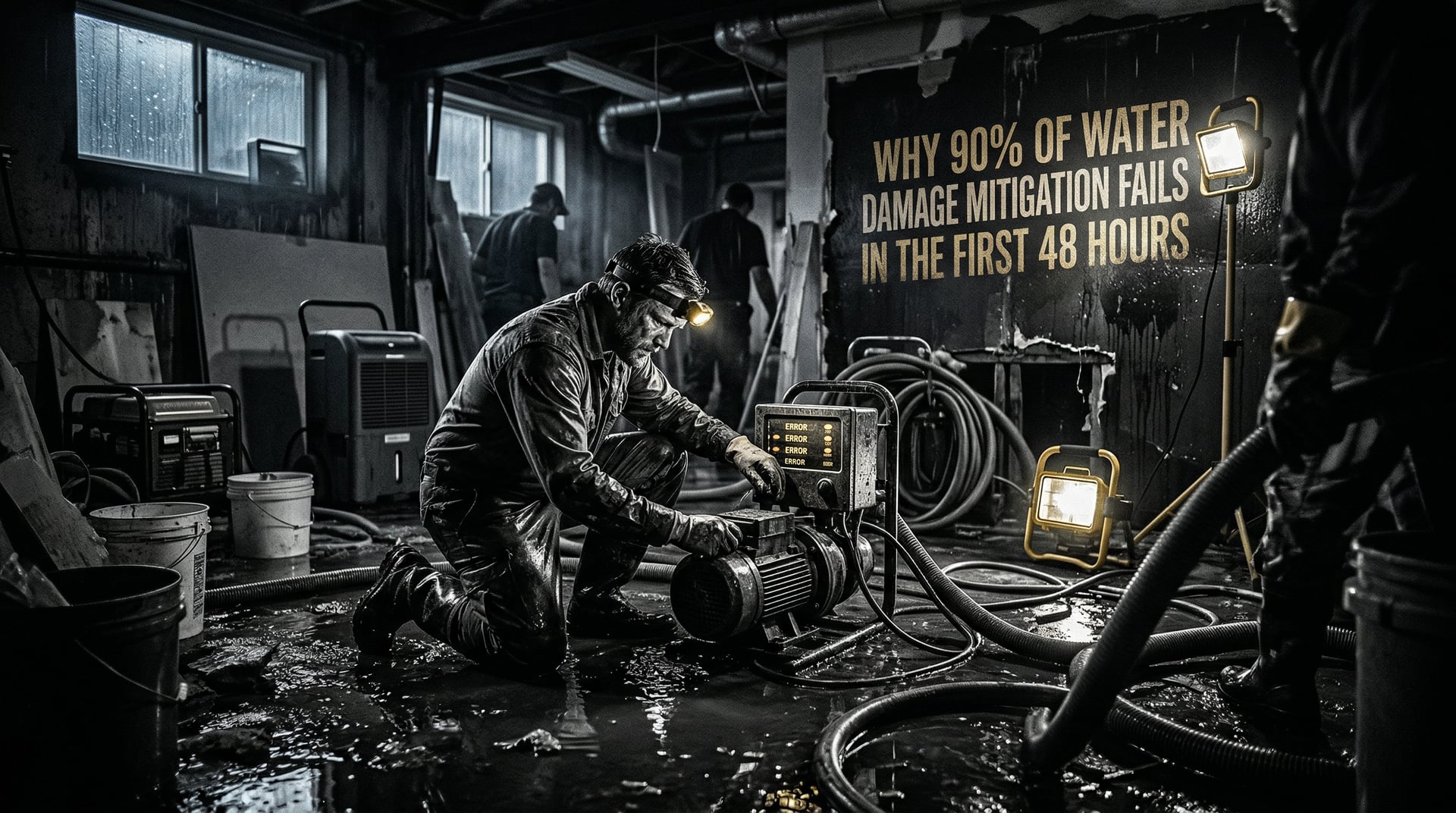
The truck rolled out at 6:14 AM. By 7:02 AM, the carrier already had a strike.
Not because the crew was late, the call came in at 5:51, the lead tech was on-site forty minutes after that, and the moisture map was started inside the hour. The strike happened because the truck rolled out with eight air movers and four LGRs for what turned out to be a 4,200-square-foot Category 2 loss that had been sitting under a slab leak since the previous Friday. By the time the supplemental gear arrived from the supply house at 11:30 AM, the IICRC clock had been ticking for almost five days. A "first-response" job became an "extraction-and-rebuild" job. Six-figure scope, three-week timeline, two of those weeks spent in negotiation with the carrier over what could and couldn’t be saved.
The crew didn’t lose the job. The supply chain lost it for them, sometime between 5:51 AM and the moment a project manager realized the truck wasn’t carrying enough equipment.
This is the part of restoration nobody puts in the marketing deck: the IICRC S500 48-hour window, the working margin between a Category 1 loss and a Category 2/3 escalation, is almost never lost on the jobsite. It’s lost upstream. In the staging yard. In the equipment ratio that was set six months ago when somebody under-bought because the off-season looked tight. In the vendor relationship that doesn’t have a 3 AM phone number.
If you run a restoration shop, an environmental contractor, or a property-side claims operation in DFW or anywhere else, you already know this. What follows is the operator-grade view of why most jobs lose the window, sourced to the standard and to the public health data.
The IICRC S500 clock starts at the loss event, not the dispatch
The most common misread of S500 by junior PMs and adjusters is the belief that the 48-hour window starts when the restoration company arrives. It doesn’t. The standard’s framework around loss categorization and the timeline of secondary damage is anchored to the moment moisture begins to interact with porous materials, which means the clock has usually been running for hours, sometimes days, before the first call ever comes in.
ANSI/IICRC S500, the consensus standard published by the Institute of Inspection, Cleaning and Restoration Certification, defines three categories of water based on contamination level. Category 1 is sanitary at the source: a supply-line break, an overflowing tub, condensate. Category 2 carries significant contamination, appliance discharge, dishwasher overflow, washing-machine pumps. Category 3 is grossly contaminated: sewage, rising floodwater, and, critically, any Category 1 or 2 loss that has been allowed to age past the point where microbial amplification becomes likely.
That last clause is where the 48-hour discipline lives. The standard treats time as a categorization input, not just a service-level metric. Once the clock has run far enough, a clean-water loss is no longer a clean-water loss, regardless of what the source plumbing looked like.
Mold growth is not a 48-hour edge case, it’s the default
The 48-hour figure isn’t restoration-industry folklore. It’s drawn from public-health and indoor-air-quality science. The EPA’s guidance is unambiguous: "If wet or damp materials or areas are dried 24-48 hours after a leak or spill happens, in most cases mold will not grow." The corollary, which the EPA’s Mold Course Chapter 2 makes explicit, is that under typical building-interior conditions, temperature in the 60s-80s, organic substrate (drywall paper, cellulose insulation, MDF baseboard), and sustained moisture, mold colonization on porous surfaces is the expected outcome, not the exception.
The CDC’s position is consistent: dampness inside buildings is a documented risk factor for upper-respiratory effects and asthma exacerbation, and the only durable mitigation is rapid moisture removal followed by structural drying.
For the restoration crew, this translates to a hard rule: every job is one bad psychrometric decision away from becoming a remediation job. The 48-hour window isn’t aspirational. It’s the threshold at which the work scope, the documentation burden, and the carrier conversation all change shape.
Most crews under-equip on the front end, and it’s not their fault
Walk a hundred Cat 2 jobs in a metro market and the same pattern shows up: the truck on scene has roughly half the air-mover capacity the structure actually needs for its loss class. Sometimes a third.
The IICRC publishes equipment-staging guidance based on loss class, Class 1 through Class 4, which describe how much of the structure is wet and how deeply moisture has penetrated. The math is laid out in the standard and in IICRC-approved coursework: an axial air mover (AMU) in a Class 2 residential loss is generally targeted at one unit per 10 to 16 linear feet of affected wall, with low-grain-refrigerant (LGR) dehumidifier capacity scaled to the psychrometric load of the structure. The exact figures depend on cubic footage, vapor pressure differential, and ambient conditions, but the floor is rarely lower than that one-AMU-per-12-feet rule of thumb.
A 4,200-square-foot loss with affected walls on the perimeter and two interior partitions can easily call for 24 to 32 air movers and four to six LGR dehus. Most first-response trucks roll with eight to twelve AMUs and one or two dehus. The shortfall isn’t a planning failure on the crew’s part; it’s a supply-chain failure that was baked in at the equipment-procurement decision months earlier.
The reason restoration shops chronically under-equip is that the unit economics of holding inventory cut against keeping enough capital tied up in idle blowers and dehus to cover the worst week of a six-month season. So the truck rolls light, the supplemental order goes in, and the supply house is either (a) closed because it’s a weekend, (b) out of stock on the specific LGR the SOW called for, or (c) two hours away because they don’t run a 24-hour dispatch.
That two-hour gap is the gap that loses the 48-hour window.
Drying and dehumidification are not the same job
The second place jobs lose the window is in confusing air movement with moisture removal. They are different physical processes targeting different parts of the psychrometric chart, and getting them confused is what produces the all-too-common scene of a structure with twenty air movers running at full tilt and a humidity reading that hasn’t moved in eight hours.
Air movers do one thing well: they accelerate the rate at which moisture moves from a wet substrate into the surrounding air. They’re vapor-pressure-differential machines. They convert bound water in drywall, framing, and contents into airborne water vapor. What they do not do, and what no amount of additional AMU capacity can do, is remove that water from the building envelope.
Removing the airborne water is the dehumidifier’s job, and the geometry of the job dictates which technology is right:
- Refrigerant (conventional) dehus work well when interior temperatures are above ~65°F and humidity is high. They condense water vapor on a cold coil and drain it.
- Low-grain-refrigerant (LGR) dehus add a heat-exchange pre-cool that drops the dew point on the coil far enough to keep removing moisture down into the 30-40 grains per pound (GPP) range, the regime where structural drying actually completes.
- Desiccant dehus use a hygroscopic wheel and are essential for cold environments, large open volumes, or when the target specific humidity is below what an LGR can hit.
The standard’s emphasis on documenting initial and ongoing psychrometric readings, temperature, relative humidity, GPP, dew point, exists precisely because the only honest way to know whether drying is happening is to measure it. "It feels less wet" is not a psychrometric reading.
The Category 2 trap and what it costs
When a Category 1 loss escalates to Cat 2, or a Cat 2 to Cat 3, through time-driven contamination, the scope of work doesn’t just expand. It changes shape.
Cat 2 work introduces antimicrobial application, additional PPE under the OSHA respiratory protection standard where disturbance generates aerosols, and selective removal of porous materials that can no longer be dried in place. Cat 3 introduces full containment, IICRC S520 remediation protocols, third-party clearance testing, and, frequently, disposal of contents that were saveable when the loss was still in the 48-hour window.
For the carrier, a Cat 1 that escalated to Cat 2/3 because of a delayed response is not a covered scope expansion. It’s a coverage conversation. For the contractor, that conversation costs the rest of the margin on the job.
The cost asymmetry is what makes the 48-hour window an economic event, not a procedural one. A first-response that lands the right equipment at the right moment locks in the lower-category scope. A first-response that lands light forces every subsequent decision into the higher-category framework, and most of those decisions cost real money.
What separates the crews that hit 48 hours
After enough loss-event reviews, a small number of operational factors keep showing up on the wins:
-
Equipment ratios are pre-staged, not improvised. The shops that consistently hit the window keep a standing inventory pegged to their worst-historical-week, not their average week. The carrying cost shows up in the P&L; the missed window shows up in the lawsuit risk.
-
The supply relationship is a 24-hour relationship. When the truck is short and the call goes out at 2 AM, the question is not "is the supply house open." The question is "how fast can the gap be closed." If that question has to wait until 7 AM, the job is already a Cat 2.
-
Moisture mapping is a discipline, not an afterthought. Moisture maps generated at hour 0, hour 4, hour 12, and hour 24 produce the documentation record that turns the 48-hour window from a contractor claim into a defensible technical position. The carriers know which contractors document and which don’t.
-
Psychrometric readings are logged as data, not impression. A consistent record of temperature, RH, GPP, and dew point at every check turns a "we dried it in 48" claim into "we dried it in 48, and here’s the curve."
-
The vendor on the other end of the phone speaks the same language. The supply houses that lose contractor business in the long run are the ones whose order desk doesn’t know the difference between an axial AMU and a centrifugal one, and can’t quote LGR capacity without putting the call on hold.
The first item is a capital decision. The next three are operational decisions. The last one is a partner decision, and it’s the one we think about every day on the supply side.
The truck that left at 6:14 won the job
The opening anecdote, the truck that rolled out at 6:14 AM and got a strike inside an hour, has the same ending as every other under-equipped first response: a six-figure scope that should have been a five-figure mitigation, three weeks of timeline that should have been one, and a carrier conversation that didn’t have to happen.
The job wasn’t lost on the jobsite. It was lost in the moment the crew chief assumed the supplemental order would close the gap before the IICRC clock did.
The work itself, the moisture mapping, the psychrometry, the structural drying, was textbook. The supply chain wasn’t. And in restoration, the supply chain is the work.
When the storm hits, your supply chain shouldn’t break.
That’s why we built Stampede the way we did: full-category inventory on the shelf instead of on a purchase order, a direct line to contractor accounts at any hour, and a vendor partnership that knows the difference between an LGR and a desiccant without having to look it up. The 48-hour window isn’t ours to make or lose, that’s the crew’s job. But the equipment ratio that determines whether the window is winnable in the first place? That’s a supply-side problem. It’s the one we wake up thinking about.
If you’re rebuilding your equipment ratios for 2026, or you’re tired of the supplemental-order loop costing you the margin on jobs you should have closed clean, we should talk. Field reports like this one are how we share what we’re seeing across the verticals we serve. New ones will land here regularly.
The next 48 hours start before the call comes in.
Sources
- ANSI/IICRC S500: Standard for Professional Water Damage Restoration
- EPA, A Brief Guide to Mold, Moisture and Your Home
- EPA Mold Course, Chapter 2: Why and Where Mold Grows
- CDC, Basic Facts About Mold and Dampness
- Restoration Industry Association (RIA)
- ASHRAE Handbook, Fundamentals (Psychrometrics)
- OSHA, Respiratory Protection Standard 29 CFR 1910.134

DFW-based distributor of restoration, abatement, and environmental supplies. Built to give crews a partner, not a vendor.