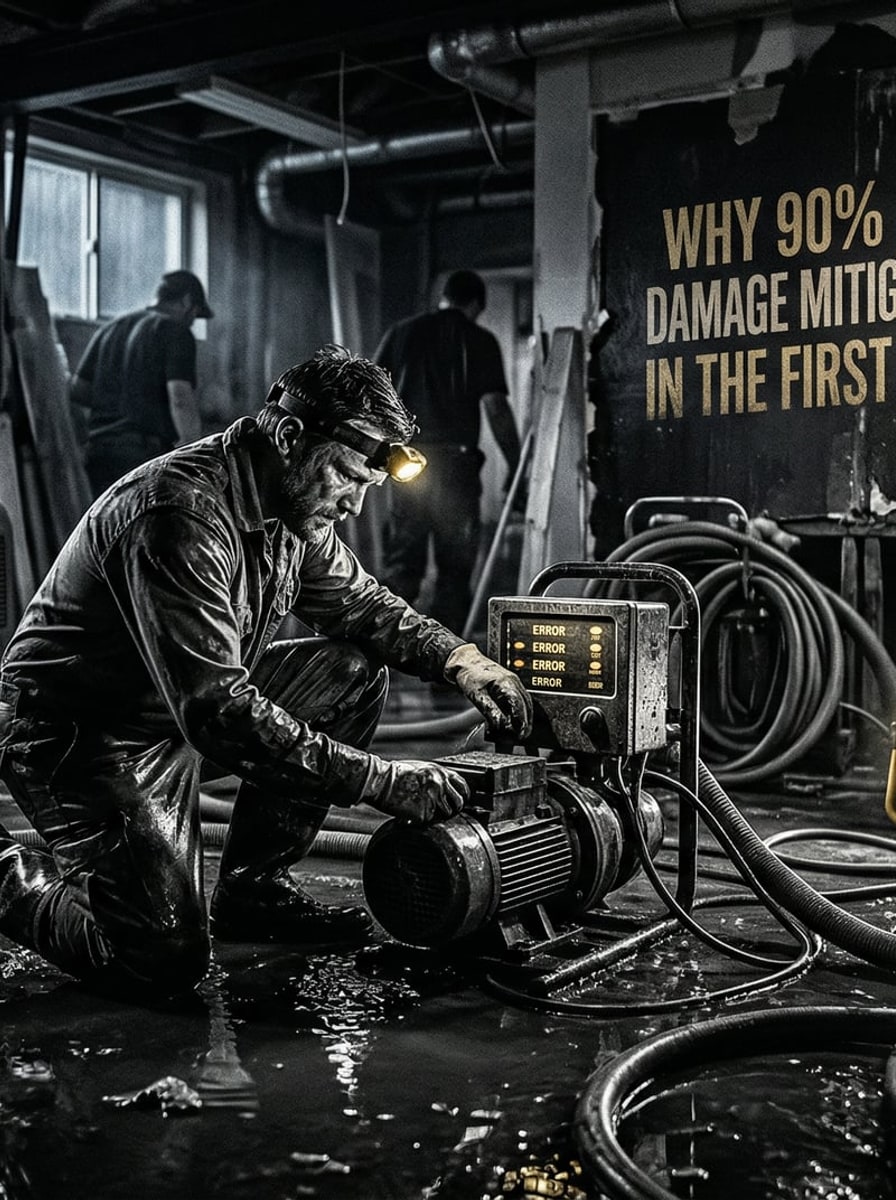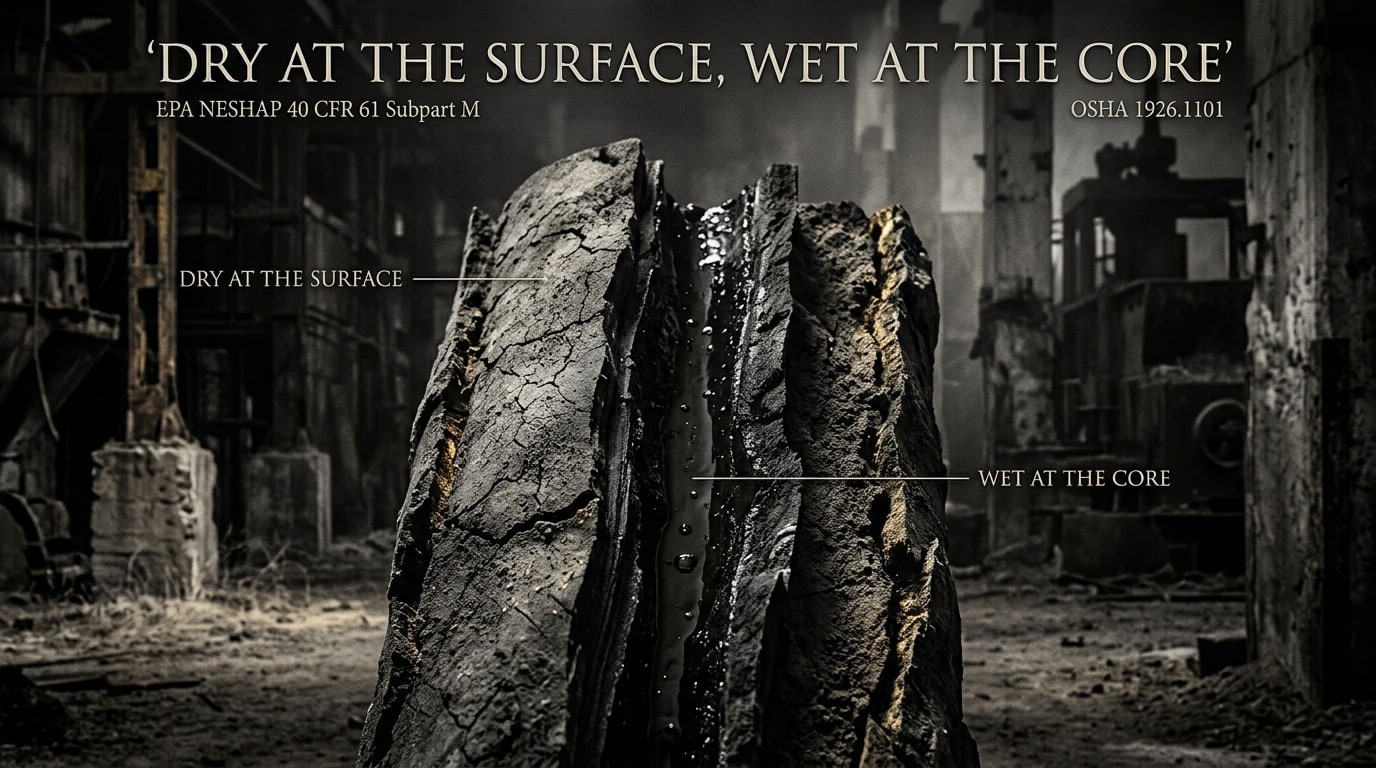
The hardwood read dry on day four. The tech ran a pinless meter across the floor, board after board, and the scan came back at the reference value the crew had set on move-in. Air movers came off the floor, the dehus went back on the truck, the drying log closed clean, and the job was signed as complete. Textbook mitigation on a residential kitchen loss.
Sixteen days later the homeowner called. The floor was cupping at the seams, the boards nearest the dishwasher had lifted, and there was a musky smell coming up through the toe-kick. The reinspection told the whole story: the surface of the boards was bone dry, exactly as the meter had said. The plywood subfloor and the sleepers underneath were still holding water at levels that had never left, because nothing on that job ever measured them. The finished floor had dried. The assembly under it had not.
That job was a Class 4 loss the entire time. Nobody called it one, so nobody dried it like one, and the meter that "cleared" the floor was answering a question about the surface while the money was buried three layers down.
Class 4 is a different physics, not a bigger Class 3
Most water losses live in IICRC S500's Classes 1 through 3, which describe how much of a space is wet and how porous the wet materials are. Class 4 is not the next step up that ladder. It is a different problem. The standard defines Class 4 as a specialty drying situation: wet materials with very low permeance and porosity, hardwood, plaster, brick, concrete, lightweight concrete, and stone, or low-evaporation built-up assemblies like multilayer subfloors and gym floors.
The water in a Class 3 carpet-and-pad loss is mostly free water, sitting in open pore space, evaporating readily into moving air. The water in a Class 4 loss is largely bound water, absorbed deep into dense material that resists giving it back. S500 is explicit that these losses "may require longer drying times, specialized methods, and substantial water vapor pressure differentials" to reach dry standard. You cannot brute-force a Class 4 with more axial air movers. The material does not release its water on the timeline an AMU array assumes.
The meter answered a question about the surface
The failure in the opening was not a bad tech. It was the wrong measurement trusted as if it were the right one. Moisture meters do not read "the floor." They read what their technology can reach:
- A pinless (capacitance) meter senses moisture in a shallow zone below the surface, and it is sensitive to what material is directly under the sensor. Scan the top of a finished board and it tells you about the top of the board, not the plywood two layers beneath it.
- A pin (resistance) meter reads between its probes, so its depth is the depth of the pins, and its accuracy depends on species and temperature correction.
- Neither one reports the subfloor and framing unless you deliberately measure into them, with penetrating probes, at the depth where the bound water actually lives.
A single-plane surface scan on a multilayer assembly is a partial read presented as a complete one. The number is real. It just does not describe the part of the structure that stays wet.
The last increments are the slow ones, and that is where jobs quit
Drying a dense material is not linear. The free water leaves relatively fast, and then the curve flattens hard as the remaining bound water clings to the material and comes off only under a sustained water vapor pressure differential. The dangerous part of that curve is the middle: the surface has released its free water and reads dry, while the core is still working through the slow bound-water tail.
A crew that demobilizes when the surface clears is quitting exactly at the point where the hardest, slowest, most important drying still has days to run. And because the assembly is now sealed under a dry-looking surface with the air movers gone, the trapped moisture has nowhere to go but sideways, into the subfloor, the sleepers, the wall base, where it becomes the conditions mold needs to colonize.
The specialty methods exist because AMUs are not enough
Class 4 is a specialty class because it demands specialty equipment, matched to the geometry of a sealed, low-permeance assembly:
- In-place / injection drying systems force dry air directly into the cavity, under hardwood, into wall assemblies, into subfloor layers, so the drying happens where the bound water is instead of at a surface the moving air can reach anyway.
- Desiccant dehumidification drives the specific humidity down far below what a conventional or even LGR refrigerant dehu can hit, creating the deep vapor pressure differential that pulls bound water out of dense material.
- Directed heat raises the material's vapor pressure so the water wants to leave, accelerating the slow tail of the curve when it is applied and monitored correctly.
- Penetrating and thermo-hygrometric measurement at multiple depths and locations, so the drying goal is the assembly reaching dry standard, not the surface reaching it.
This is the same discipline that separates a defensible water job from an argument with the carrier. A moisture map turns "we dried it" into a documented technical position: The Moisture Map That Saves the Scope. And the clock that makes all of this urgent is the same one that governs every water loss from the jump: Why Most Water Damage Mitigation Fails in the First 48 Hours.
What separates the crews that dry the assembly
After enough Class 4 reinspections, the crews that never generate the two-week callback share a short list of habits, most of them decided before the truck rolls:
- They classify the loss honestly. Hardwood, plaster, concrete, or a built-up assembly gets called Class 4 on day zero, which changes the equipment plan and the timeline expectation up front.
- They measure at depth. Penetrating probes into the subfloor and framing, at set locations, logged over time, so dry standard means the assembly and not the surface.
- They bring the specialty gear the class requires. Injection or in-place systems, desiccant capacity, directed heat, not just a bigger pile of air movers.
- They hold the differential. The drying is managed as a vapor-pressure problem, with the specific humidity driven low enough and long enough to work the bound-water tail all the way down.
- They demob on assembly data, not surface impression. The floor looking dry is not the exit criterion. The core reaching dry standard is.
The supply-side version of a cupped floor
A Class 4 callback looks like a technician judgment error, and partly it is. Underneath it, most of the time, is a supply and equipment problem wearing a judgment costume: the crew never had injection drying on the truck, never had desiccant capacity to hit the specific humidity the material demanded, never had penetrating meters to read the layer that mattered. So they dried what the standard air did reach, cleared the surface, and left the bound water sealed in.
That is why we stock structural drying as a class-aware system, not a pallet of blowers. Injectidry In-Place and Injection Drying SystemsInjectidry to dry the cavity where the bound water lives, Desiccant and LGR Dehumidifiers plus Delmhorst / Protimeter Penetrating MetersPhoenix / Delmhorst / GE Protimeter to create and verify the deep differential, and the thermo-hygrometers and documentation tools that make dry standard a measured fact instead of a signed impression. Water damage supply is not won by owning the most air movers. It is won by drying the assembly the surface is hiding.
Before the next hardwood, plaster, or slab loss gets signed as complete, ask the one question that decides whether it is finished or filed: what is the moisture content of the subfloor and the framing at depth, and who measured it? If the only reading on the log is a surface scan, the job dried the floor and left the loss.
If you are building out your Class 4 capability for 2026 and want the injection drying, the desiccant capacity, and the penetrating measurement specified as one specialty-drying system, we should talk. Field reports like this one are how we share what we are seeing across the verticals we serve.
Sources
- ANSI/IICRC S500: Standard for Professional Water Damage Restoration
- Institute of Inspection, Cleaning and Restoration Certification (IICRC)
- ASHRAE Handbook, Fundamentals (Psychrometrics)
- EPA, A Brief Guide to Mold, Moisture and Your Home
- CDC, Basic Facts About Mold and Dampness
- Restoration Industry Association (RIA)

DFW-based distributor of restoration, abatement, and environmental supplies. Built to give crews a partner, not a vendor.