IICRC S520 ALIGNED
Contain, capture, clean, in that order, or it's a re-do.
Negative-air machines, zip-wall containment, HEPA vacuums, botanical and EPA-registered antimicrobials, encapsulants, and moisture verification gear for crews working to the IICRC S520 Condition 1 standard.
The IICRC S520 Standard for Professional Mold Remediation frames the work in three non-negotiable steps: contain the affected area, capture airborne spores during removal, and clean and verify return to Condition 1 (a normal fungal ecology for an indoor environment). Skip containment and you contaminate every adjacent assembly. Skip HEPA capture during disturbance and the post-remediation clearance test fails. Skip verification and the insurer, the hygienist, or the occupant's attorney runs the clearance for you.
The expensive mistake most mold crews make is treating the job as a cleaning job when it is a physics job. Spore disturbance during removal generates an aerosol that, absent negative pressure and HEPA filtration, migrates through every wall penetration and HVAC return in the structure. The EPA’s guidance on Mold Remediation in Schools and Commercial Buildings is explicit on the need for containment and engineering controls proportional to the remediation size. For Level 3 and 4 jobs (10–100+ sq ft), full containment with negative pressure, HEPA filtration, and decontamination chambers is standard practice.
Stampede stocks the containment and filtration stack remediators actually use: NC Filtration and Phoenix negative-air machines with true-HEPA final stages, ZipWall spring-loaded poles for rapid containment setup, Mastercraft HEPA vacuums, Bioesque Botanical Disinfectant (EPA Reg. No. 87742-1) and ICP Group’s Benefect (EPA Reg. No. 74771-1 family) for disinfection, Fiberlock Aftershock and IAQ 6000 encapsulants, Engineering Solutions pre-filters and bags, and Tramex moisture meters for verifying the moisture source is dead before rebuild. Distributed from Grand Prairie, backed by manufacturer-direct stocking depth.
What we stock
Negative-Air & HEPA Filtration
Portable negative-air machines sized by CFM and room volume, true-HEPA final-stage filters, pre-filters to extend media life, and duct kits for exhaust routing.
Containment & Zip-Wall Systems
ZipWall spring-loaded poles, poly sheeting in 4/6/10 mil, decon chamber kits, and adhesive-backed zipper doors for rapid Level 2 and Level 3 containment builds.
Antimicrobials, Biocides & Encapsulants
Bioesque botanical disinfectant, Benefect Decon 30, Fiberlock mold-control cleaners, Aftershock, and IAQ 6000 encapsulants, matched to S520 Condition 1 verification workflow.
Moisture Meters & Air Sampling Support
Tramex pinless meters, pin-type probes, hygrometers, and replacement cassettes to verify the moisture source is resolved before rebuild and document the clearance trail.


Common questions
When is negative-pressure containment actually required?
The EPA's guidance scales containment to remediation size. Limited containment is typical for 10–100 sq ft; full containment with negative pressure, HEPA filtration, and decontamination chambers is the default for areas larger than 100 sq ft and for any job involving sensitive occupants. IICRC S520 aligns with a similar condition-based framework. In practice: if you're disturbing contaminated material, assume you need negative pressure until you've proven you don't.
Does Stampede stock EPA-registered botanical disinfectants?
Yes. Bioesque Botanical Disinfectant Solution and ICP Group's Benefect lines are EPA-registered and widely specified for IAQ-sensitive environments (schools, healthcare, occupied commercial). We also carry conventional quaternary-ammonium and hydrogen-peroxide-based chemistries for crews whose specs require them.
How do I avoid failing a post-remediation clearance test?
Three chronic culprits: (1) containment breach during removal, negative pressure drops, spores migrate; (2) inadequate HEPA cleaning cycles after removal but before sampling; (3) unresolved moisture source, if the substrate is still wet, you will re-colonize before the clearance letter is signed. A moisture meter reading at equilibrium, confirmed HEPA vacuum passes, and documented negative-pressure maintenance are the standard defenses. Our Tramex and negative-air equipment is selected specifically for this documentation chain.
What encapsulants work on framing lumber post-HEPA cleaning?
Fiberlock Aftershock and IAQ 6000, and Foster 40-50 are widely used. The encapsulant is a belt-and-suspenders measure, it is not a substitute for removal of contaminated porous material. Applied over properly remediated framing it provides a bonded film that resists re-colonization and gives the verification trail something tangible to photograph.
Can you supply a full mold-job kit (containment + filtration + chemistry) in one order?
Yes. One of the reasons contractors consolidate with us is precisely this, a single PO with ZipWall poles, poly, negative-air machines, HEPA filters, Bioesque or Benefect, Fiberlock encapsulant, and documentation forms goes out on one truck. Fewer POs, fewer delivery windows, fewer missed items.
FIELD REPORTS
From this vertical

Mold Remediation
The Negative-Air Math Most Jobs Get Wrong
A containment does not care how many machines are on site. It cares about cubic footage, true CFM under load, and whether pressure holds when the work starts.
Mold Remediation
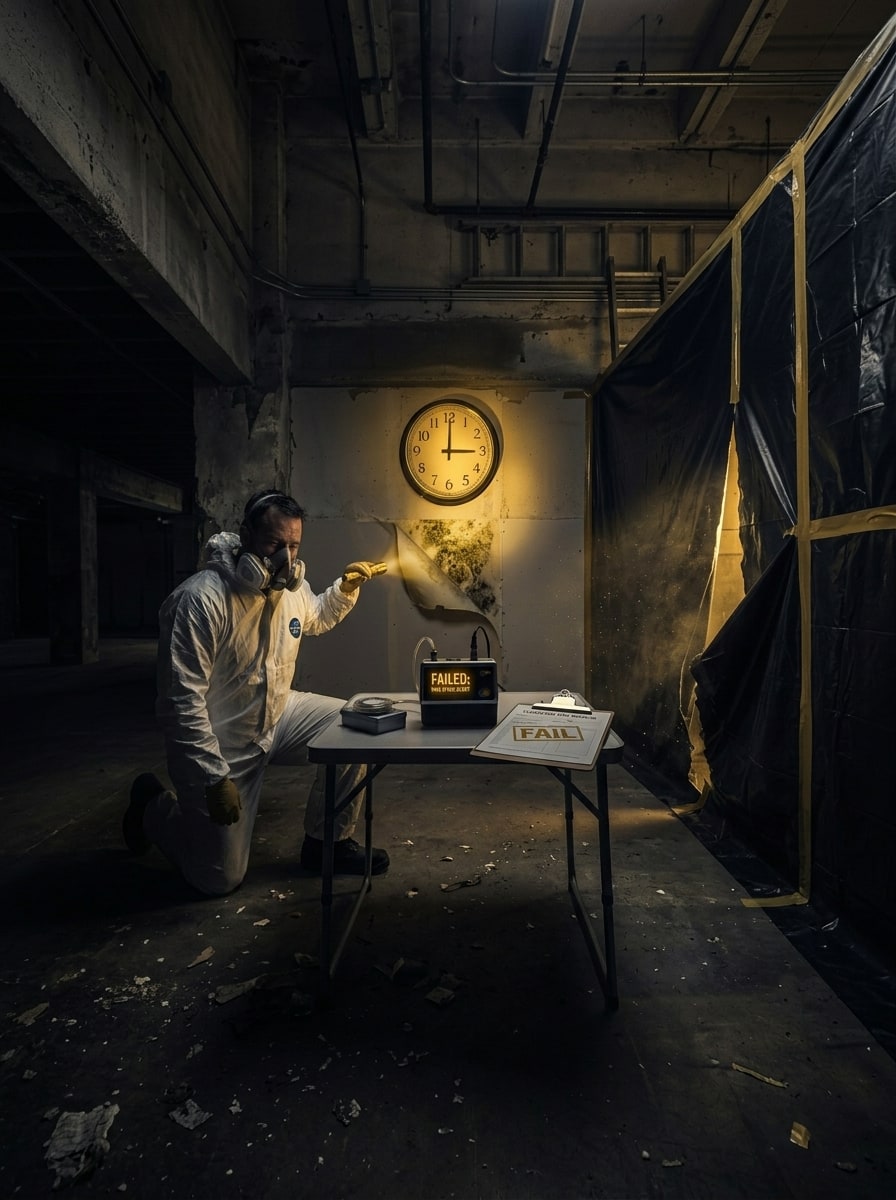
The Clearance Test That Fails at 3 PM: Three Failure Modes That Kill Mold Remediation Jobs
IICRC S520 Condition 1 is not subjective. Neither are the three ways crews keep missing it.
You might also need
Restoration
Water Damage Restoration
We stock LGR dehumidifiers, axial and centrifugal air movers, truck-mount and portable extractors, moisture meters, and thermal imagers in Grand Prairie, ready for same-day pickup when a Cat 3 loss is on the board.
Hazmat
Asbestos & Lead Abatement
Negative-air machines, HEPA pre-filters and bags, critical-barrier poly, decon chamber components, chemical sealers, and abatement-spec PPE for crews working to OSHA asbestos and lead standards.