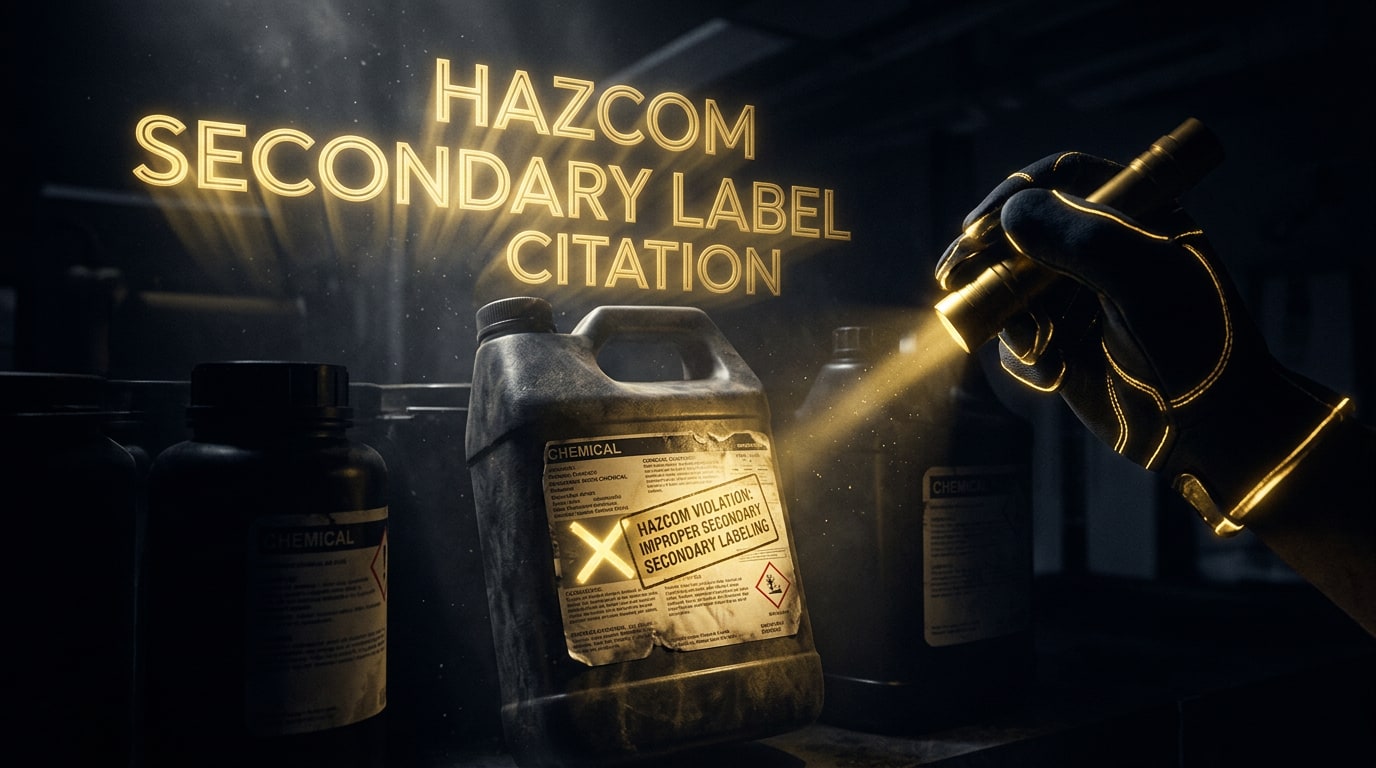
The inspection did not start with anything dramatic. No injury, no spill, no complaint. A compliance officer was on site for something unrelated, walked past a janitorial cart in a corridor, and picked up a blue spray bottle. The bottle held a diluted disinfectant decanted from a concentrate that morning. It had a faded handwritten "GC" on masking tape and nothing else. No product name. No hazard information. No way for anyone but the person who filled it to know what was inside.
That bottle was a Hazard Communication violation, and it was not the only one on the cart. The trigger sprayer of degreaser had no label at all. The mop bucket of floor stripper was unmarked. The safety data sheets were in a binder in a closet two floors away that the day-shift custodian had never been shown. None of it had hurt anyone. All of it was citable, and the quietest object in the building, a spray bottle, was the headline.
This is the citation nobody braces for, because it does not look like a hazard. It looks like housekeeping. But Hazard Communication, 29 CFR 1910.1200 is year after year one of OSHA's most frequently cited standards, and in facilities and janitorial operations the most common way to land on that list is the secondary container that never got labeled.
What HazCom actually requires of a facilities operation
The Hazard Communication Standard is built on a simple principle: a worker has the right to know what chemicals they are working with and how to work with them safely. For any facility that uses cleaning chemicals, and that is every facility, the standard imposes a short list of non-negotiables:
- A written hazard communication program. It has to exist, on paper, describing how the site handles labels, safety data sheets, and training.
- Safety data sheets, accessible. An SDS for every hazardous product, available to workers on every shift without barriers, not locked in a manager's office.
- Labels on containers. Manufacturer containers keep their GHS labels. Secondary containers, the spray bottles and buckets you fill from a concentrate, have to be labeled too.
- Training. Workers trained on the hazards, the labeling system, and how to read an SDS, in a language they understand.
The standard is aligned to the Globally Harmonized System (GHS), and OSHA's 2024 final rule updated HazCom to a newer GHS revision, tightening label and SDS requirements. The framework is mature and well documented. The failures are almost never about not knowing the rule. They are about the rule not surviving contact with a busy cart.
The secondary container is where it breaks
The manufacturer's jug of concentrate is rarely the problem. It arrives with a compliant GHS label, and it sits in a supply room. The problem is the moment that concentrate is diluted into a spray bottle, a trigger sprayer, or a bucket. That is a secondary container, and the standard does not exempt it.
A secondary container has to be labeled with the product identity and the hazard information. OSHA gives employers two compliant routes: reproduce the full GHS label (identity, signal word, pictograms, hazard and precautionary statements), or use an in-house workplace labeling system, product name plus hazard information conveyed by words, pictures, symbols, or a combination, as long as it gets the hazard across and the SDS backs it up.
There is exactly one narrow exception, and crews lean on it wrongly: a container is exempt only if the worker who fills it uses up the entire contents within their own shift and the container never leaves their control. The bottle that sits on the cart overnight, gets handed to the next shift, or is set down in a corridor is not that. It needs a label, period.
Why this is the citation that compounds
A single unlabeled spray bottle looks trivial. The reason it matters is that it is rarely single, and it rarely travels alone. The cart with one unlabeled bottle usually has an SDS access gap and a training gap behind it, because all three come from the same root: the chemical program was set up once and never maintained at the point of use.
So the inspector who picks up one bottle pulls a thread. No label leads to "show me the SDS for this," which leads to "show me your written program," which leads to "show me this crew's training records." A two-second observation becomes a multi-item inspection, and each item is independently citable. The quiet violation is expensive precisely because it is a symptom the inspector knows how to follow.
And underneath the citation is a real exposure. An unlabeled secondary container is how a custodian mixes incompatible chemistry, how a new hire sprays a concentrate they thought was diluted, how an emergency responder cannot tell a first responder what someone was exposed to. The label is not bureaucracy. It is the thing that lets the next person work safely with what you left on the cart.
The fix is a system, not a scolding
Telling crews to "label the bottles" does not work, because the failure is structural, not attitudinal. The bottle goes unlabeled because there was no label within reach when it was filled, no standardized system, and no restock discipline. The durable fix is to make the compliant choice the easy one:
- Pre-printed secondary labels at the dilution station. GHS-format or workplace-format labels for every product the site dilutes, stocked where the filling happens.
- A maintained SDS system, on every shift. Binder or digital, but actually accessible at the point of work, with the matching SDS for everything in use.
- Standardized bottles and color coding tied to the labeling so the system is legible at a glance and survives shift changes.
- Restock as part of the par program. Labels and SDS access treated like any other consumable that runs out and gets reordered, not a one-time setup that decays.
The supply-side version of right-to-know
Facilities work is consumption-driven. The failure mode is not a dramatic emergency, it is a quiet stockout, the labels that ran out, the SDS that never got updated when the chemistry changed, the standing order that lapsed. That is the supply problem hiding inside the compliance problem, and it is the one we built the facilities program to solve.
We stock the chemistry and the boring SKUs that keep it compliant: Bioesque Disinfectants + GHS Labeling and SDS SuppliesBioesque / Facilities Stack, secondary-container labels, standardized bottles, and the par-level reorder program that keeps labels and documentation from quietly running dry between audits. We are a distributor, and the unglamorous part of distribution is making sure the label is on the shelf before the inspector is in the building.
The spray bottle is the smallest object on the cart and the one most likely to fail an inspection. Label it, back it with an accessible SDS, train the crew that uses it, and the quietest citation in facilities stops being yours. The right-to-know rule is not asking for much. It is asking that the next person be able to read what you handed them.
If you manage a DFW facility or a commercial cleaning operation and want the labeling and SDS program standardized into your standing supply order for 2026, we should talk.
Sources

DFW-based distributor of restoration, abatement, and environmental supplies. Built to give crews a partner, not a vendor.