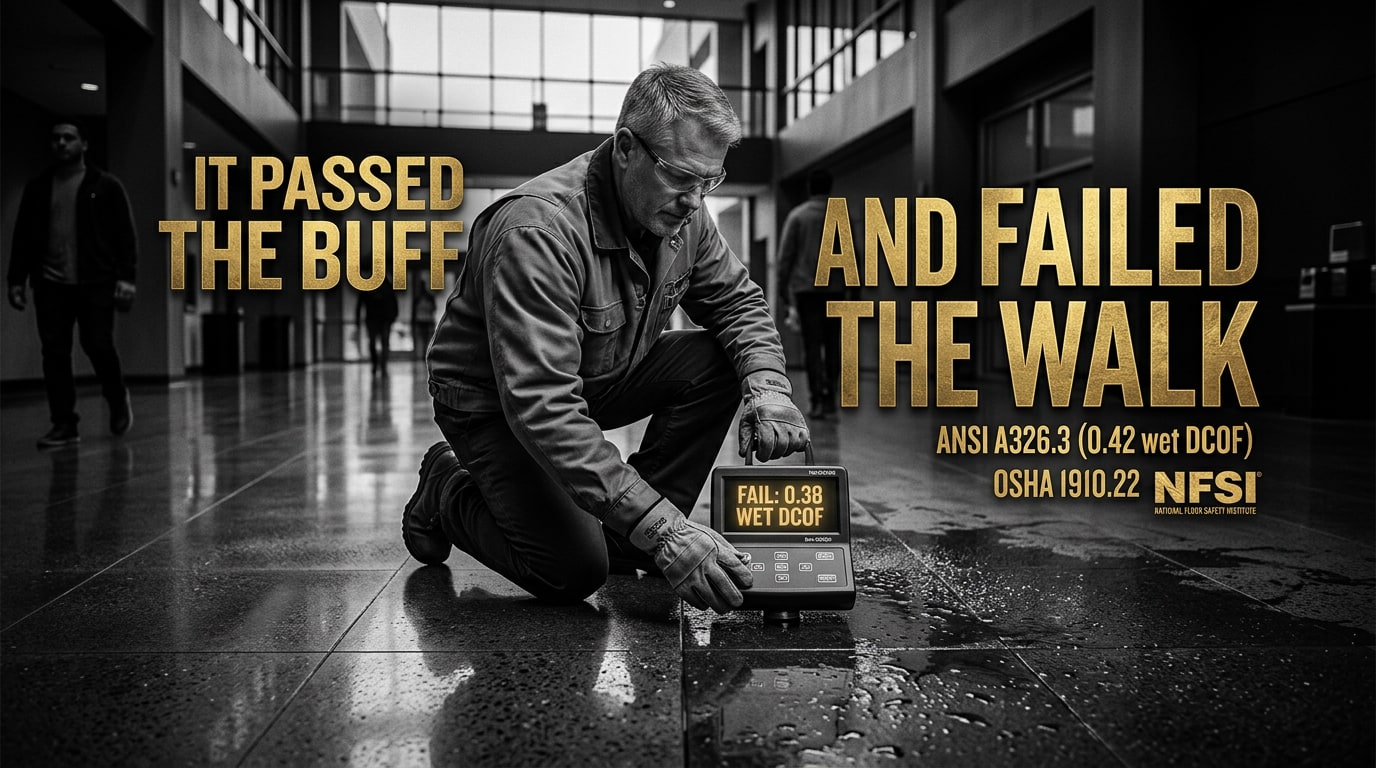
The floor was the best-looking surface in the building. The night crew had stripped it down to the substrate over the weekend, laid four coats of high-gloss finish, and burnished it to a mirror. Monday morning, the property manager walked the lobby and signed off with a photo for the owner. By 9:40 AM, a visitor in dress shoes came through the entrance with rain still on the soles, hit the twelve feet of glass-smooth floor just inside the vestibule, and went down hard enough to call an ambulance.
The floor did not fail because the crew was careless. The strip was clean, the coats were even, the shine was showroom. It failed because "looks immaculate" and "holds traction when wet" are two different measurements, and the finish that was purchased optimized the first at the expense of the second. Nobody in the chain, not the distributor, not the night crew, not the property manager, ever put a number on the surface. So the number that mattered showed up in a claim file instead of on a spec sheet.
This is the quietest liability in facilities work. Slip-and-fall on a walking surface is not an act of God. It is a measurable property of the floor, governed by a published consensus standard, and the property that governs it is set months before the fall, in the finish chemistry and the pad someone put on the purchase order.
Slip resistance is a number, and the number is 0.42
The floor-industry answer to "how slippery is too slippery" is not a judgment call. It is ANSI A326.3, the consensus standard for measuring the dynamic coefficient of friction (DCOF) of hard-surface flooring, published through the Tile Council of North America. DCOF is the friction available between a shoe and the floor while both are already in motion, which is the physics of an actual slip, not the static grip of a foot standing still.
The standard sets floor-by-condition minimums. For a level interior surface that will be walked on wet with water, the floor must return a wet DCOF of 0.42 or greater, measured with a standardized SBR sensor and an SLS wetting solution. Wetter and more demanding conditions raise the bar from there:
- Interior, wet with water: 0.42 minimum
- Interior, wet "plus" (residues, tracked-in moisture): 0.50 minimum
- Exterior, wet: 0.55 minimum
- Oils and greases present: 0.55 minimum
The mirror-shine lobby floor is the classic trap. A hard, dense, freshly burnished finish can read beautifully to the eye and slide right under the 0.42 line the moment water is introduced, because gloss and grip are not the same variable. The gloss came from the finish and the burnish. The grip had to be engineered in, and on that job it never was.
OSHA does not test your DCOF. It cites the outcome.
There is a common misread that because OSHA does not walk in with a friction meter, slip resistance is not a regulatory issue. It is. The OSHA Walking-Working Surfaces standard, 29 CFR 1910.22, requires that walking-working surfaces be kept "in a clean, orderly, and sanitary condition" and, as far as feasible, "in a dry condition," with a means to maintain traction where wet processes are used. OSHA's 2017 update to the walking-working surfaces rules put same-level slip, trip, and fall hazards squarely inside general-industry enforcement.
Same-level falls are not a rounding error in the injury data. They remain one of the largest categories of nonfatal workplace injury tracked by the National Safety Council, and a facility that put a fresh coat of low-traction finish on a public floor owns both the OSHA exposure for its own staff and the premises-liability exposure for everyone who walks in the door.
The National Floor Safety Institute exists precisely because this is a supply-and-maintenance problem with a paper trail. When a claim is filed, the defensible position is the same one that defends a silica or a decon file: which product, what traction rating, verified how, maintained on what schedule. "It looked clean and dry" is not a record. A DCOF reading is.
Where the traction is actually won or lost
Walk a hundred slip-and-fall lobbies and the failure clusters in a handful of upstream decisions, none of them made on the morning of the fall:
- The finish was chosen for shine, not traction. High-solids gloss finishes build a hard, smooth film. Without a traction-engineered formula or an anti-slip additive, that film can sit under the wet DCOF threshold the day it cures.
- The pad and the burnish drove gloss up and grip down. Aggressive burnishing to a mirror can further smooth the surface. Gloss went up, DCOF went down, and nobody measured the trade.
- The entry system was undersized. The first twelve to fifteen feet inside a door is where tracked-in water lives. Too little walk-off matting means the wet zone extends onto the finished floor exactly where foot traffic is heaviest.
- Nobody owns a meter. If no one in the building can produce a DCOF reading, the floor's slip resistance is an opinion until a fall converts it into evidence.
Matting is not an accessory. It is part of the traction system.
The cheapest DCOF you will ever buy is the water that never reaches the finished floor. A properly specified entrance system, scraper matting outside, absorbent walk-off matting for the first several strides inside, pulls tracked-in moisture off the shoe before it hits the coated surface. Skimp on matting and you have moved the wet-DCOF problem from a controllable transition zone onto the finished floor, where the only remaining defense is the traction of the finish itself.
This is the same system-versus-component trap that runs through the rest of the trades. A correctly sized dust extractor is what makes a silica control compliant rather than the blade alone: Table 1 Says Compliant. Your Silica Dust Says Otherwise. On a floor, the entrance matting, the finish chemistry, and the maintenance cadence are the system. Buy one and skip the other two and the floor is a fall waiting for rain.
The supply-side version of a slip-and-fall
The dwell on a slip-and-fall claim always lands on the janitorial crew, and partly that is fair. But underneath most of them is a supply decision wearing a maintenance costume:
- The wrong finish. A gloss-first product with no traction rating, bought because it looked good in the hallway, not because anyone checked its wet DCOF.
- No traction additive on the shelf. Anti-slip grit additives that raise the DCOF of a finish exist and cost very little. They are not on the truck because nobody specced them.
- Undersized entrance matting. The single most effective wet-floor control, cut to save a line item.
- No verification tooling. No meter, no reading, no record, so the floor's compliance is a story until it is a lawsuit.
That is why we treat floor safety as a specified system, not a jug of shine. We stock High-Traction Floor Finish and Anti-Slip Grit AdditivesBetco for the coated surface and Safety-Walk Slip-Resistant Tapes and Treads3M for the transitions, ramps, and wet zones that no finish alone should be asked to carry, alongside the entrance matting that keeps the water off the floor in the first place. Facilities supply is not won by the deepest shine in the lobby. It is won by the floor that still grips when it rains.
Before the next strip-and-refinish goes on the schedule, ask the one question that decides whether the floor is an asset or a claim: what is the wet DCOF of the finish going down, and who is going to verify it? If nobody can answer, the floor is being specified for how it looks on Monday, not for how it behaves the first time someone walks in wet.
If you are rebuilding your floor-care program for 2026 and want the finish, the additive, and the matting specified as one traction system instead of three separate line items, we should talk. Field reports like this one are how we share what we are seeing across the verticals we serve.
Sources
- ANSI A326.3: Dynamic Coefficient of Friction (DCOF) of Hard Surface Flooring Materials
- Tile Council of North America, Dynamic Coefficient of Friction Resource Center
- TCNA, Dynamic Coefficient of Friction, Frequently Asked Questions
- OSHA, Walking-Working Surfaces 29 CFR 1910.22
- OSHA, Walking-Working Surfaces and Personal Fall Protection Systems (Final Rule)
- National Floor Safety Institute (NFSI)
- National Safety Council, Injury Facts: Falls

DFW-based distributor of restoration, abatement, and environmental supplies. Built to give crews a partner, not a vendor.