Two-forty-seven on a Tuesday morning. A 275-gallon heating-oil tote at a commercial facility in south DFW let go through a hairline crack in the welded seam. Facility tech found it at 3:04 AM on a routine walk. By 3:09 the on-call response contractor was dispatched. Boots on ground at 3:32 AM. Forty-five minutes, start to finish, on a clean weekday with no traffic.
Too long.
In the interval between 2:47 and 3:32, roughly 140 gallons of #2 heating oil had traveled down the containment pad’s slope, cleared the curb where the concrete seams had separated, and made it to the storm-drain grate 35 feet east of the tote. The grate fed a lateral that fed a municipal storm-sewer system that, four blocks away, discharged to an open drainage channel, which fed, another three miles downstream, a tributary that the state had flagged as navigable waters under the Clean Water Act.
From 3:32 AM forward, everything the response crew did, the sorbent choice at the drain perimeter, the boom placement in the channel downstream, the overpack drum dispatched to the pad, determined whether the shift ended at 6 AM with a cleaned pad and a closed report, or whether the shift ended at 6 AM with the state environmental agency on the phone and the National Response Center on the list of who needed a notification before the sun came up.
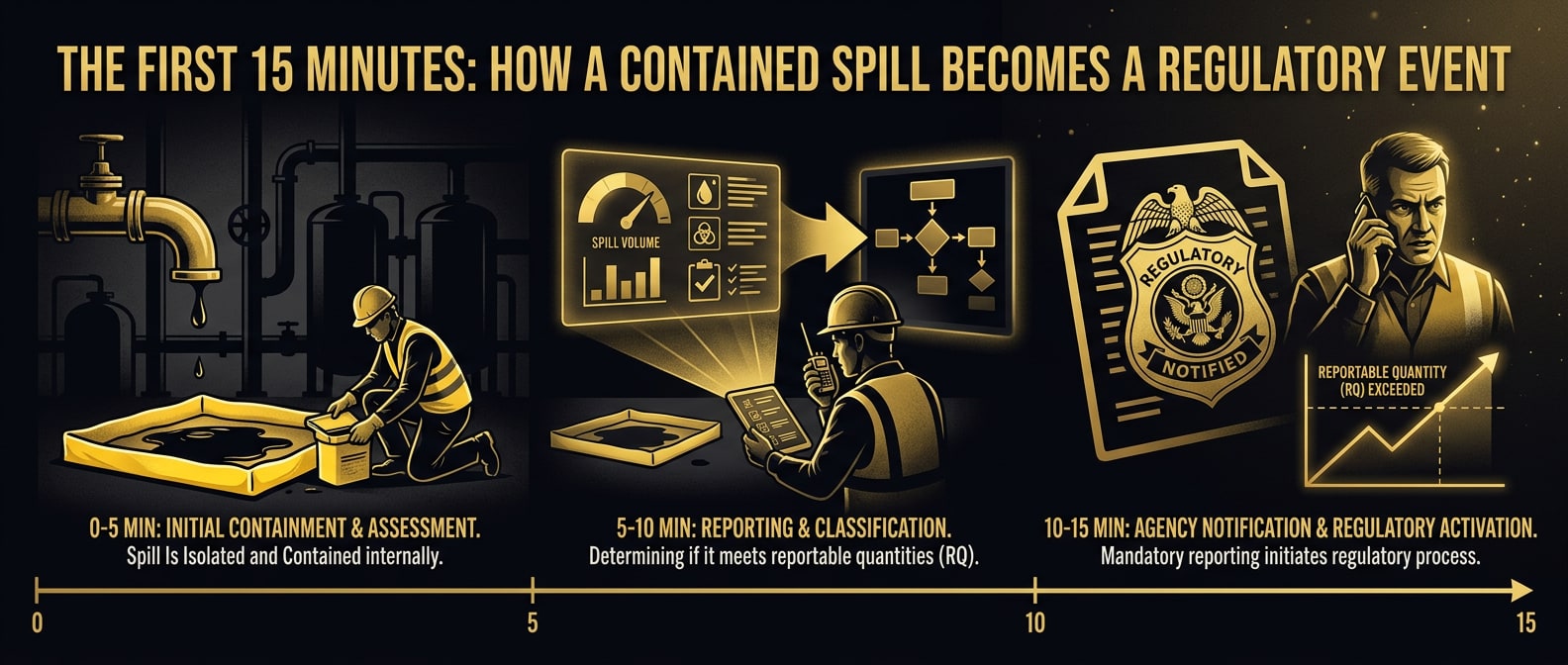
Environmental spill response is the discipline where operational decisions and federal regulatory outcomes compress into the same fifteen minutes. The response crew’s first fifteen minutes on scene, what they choose, what they deploy, what they contain and what they let run, is almost always the deciding interval between "incident handled by the on-call team" and "incident that triggers reporting to four different agencies." It is also, almost always, the interval during which the response crew is working off whatever happens to be on the truck.
Which is another way of saying: it’s a supply chain problem.
HAZWOPER is the floor, and the floor is a written program
Every hazardous-substance emergency response in the United States, from a 5-gallon hydraulic-fluid release at a forklift dealership to a train derailment carrying chlorine, sits under the OSHA HAZWOPER standard at 29 CFR 1910.120. The standard is structurally unlike most other OSHA rules: it covers not a hazard, but a scope of activity, hazardous-waste site operations, treatment, storage, and disposal facilities, and emergency response operations for releases of hazardous substances.
For emergency response, HAZWOPER defines five competency-based training tiers: First Responder Awareness (1910.120(q)(6)(i)), First Responder Operations (24 hours of training), Hazardous Materials Technician (24 hours and more field competency), Hazardous Materials Specialist, and On-Scene Incident Commander. Each tier has specific scope-of-work limits. A First Responder at the Awareness level is trained to identify and notify, they are explicitly not permitted to take offensive action to stop a release. A Technician is trained and equipped to plug, patch, and contain. The distinction matters on scene: a crew member acting outside their HAZWOPER tier is a 1910.120 violation waiting on an inspection, regardless of how well the work turned out.
The written-program requirements layered onto that, Emergency Response Plan, Hazard Communication integration per 29 CFR 1910.1200, PPE programs under 29 CFR 1910.132, medical surveillance, are substantial. None of them are the distributor’s job to enforce.
What is the distributor’s job is to make sure the response crew that shows up with a 24-hour Technician certification in its pocket has the right sorbent, the right overpack, the right cartridge, the right boom on the right truck. A compliant crew with the wrong supplies is operationally identical to a non-compliant crew.
Oil-only vs universal: the single most expensive mis-pick
The sorbent decision at minute three is the decision that most often separates a contained release from a reportable one, and the two-sorbent-color rule exists specifically because of it.
Oil-only (hydrophobic) sorbents, conventionally dyed white, selectively absorb hydrocarbons and leave water behind. They’re made from polypropylene with a hydrophobic finish, and their critical advantage is on water: a white boom deployed across a sheen on a retention pond or a drainage channel will absorb the petroleum fraction while floating on the water surface, which is the only reason recovery of an oil-on-water release is operationally feasible at all.
Universal (gray) sorbents absorb both aqueous and hydrocarbon phases without discrimination. They’re the correct choice for unknown chemistries on hard surfaces, for non-hydrocarbon chemical releases, and for indoor spills where water-phase involvement is unlikely. On water, they sink. On a hydrocarbon sheen floating on water, they’re the wrong tool, they saturate with water before they absorb the oil, and the boom becomes a weighted object rather than a recovery device.
Hazmat (yellow / chemical-grade) sorbents are formulated for aggressive chemistries, acids, bases, solvents, and are labeled for the specific compatibility ranges the manufacturer tests against. They are not a universal replacement for universal sorbent; they are a specification-driven choice based on the release chemistry.
The expensive mis-pick, the one that shows up on enough after-action reports to be a pattern, is deploying gray universal sorbent against an oil-on-water release because it was the sorbent the crew had in quantity on the truck. What happens next is predictable: the boom saturates with water and sinks below the sheen. The sheen continues to travel downstream. By the time the correct oil-only product arrives from the supply house, the release has moved past the containment point and into a water body where recovery shifts from a mechanical-absorbent problem to a boom-and-skim operation that requires different equipment, different training, and different regulatory paperwork.
The math here is unforgiving. A release of heating oil that starts at 140 gallons and escapes onto water becomes a visible sheen at concentrations in the low parts-per-billion, well below the threshold at which the release is recoverable as a mass of liquid. The sorbent choice at minute three is the decision that determines whether the oil is still a recoverable mass at minute twenty or whether it’s been diluted into a sheen that requires agency coordination to clean up.
Containment before recovery, every time, without exception
The other operational rule that the best response crews execute reflexively is: contain the perimeter before recovering the volume. That sequencing isn’t preference. It’s physics.
A release onto a hard surface with a slope, which describes a containment pad, a warehouse floor, a loading bay, a parking lot, most facility environments, is an active flow problem until the perimeter is contained. Until that moment, every minute spent recovering the source volume is a minute the perimeter is still growing. Recovery-first on an uncontained release is operationally the same as trying to empty a bucket with a hole in the bottom.
The practical containment sequence on a hydrocarbon pad release, in order:
- Perimeter socks and booms, placed downstream and down-slope, establishing the containment envelope before any recovery work begins.
- Drain covers and seal mats on any floor drains, storm grates, or utility openings within or immediately adjacent to the release footprint. If the release has already reached a drain, a containment boom goes on the downstream manhole or catch basin next.
- Secondary containment staging, a portable berm or an overpack drum arrangement, positioned to receive the recovered product and the spent sorbent. Until the recovery container is on site and staged, the crew has no terminal storage, which means the next step has nowhere to go.
- Source control, stopping the release at its origin via plug, patch, repositioning, or, if the tank or drum is compromised, overpack into a larger-diameter DOT-specification container.
Only after those four steps is the crew in a position to begin bulk recovery with pads, socks, extraction pumps, or vacuum trucks. A crew that inverts this order because the volume looks alarming, a natural human response, spends the next thirty minutes chasing a perimeter that keeps running ahead of them.
The organic-vapor cartridge most crews get wrong
The PPE decision on a hydrocarbon release sits under both 29 CFR 1910.134 for the respiratory program and the broader PPE program at 29 CFR 1910.132. The OSHA emergency-response PPE levels, Level A (full encapsulated, SCBA), Level B (SCBA with non-encapsulated suit), Level C (air-purifying respirator plus chemical-protective suit), Level D (work uniform, no respiratory protection), describe the required protection tier based on the hazard and exposure profile.
For a hydrocarbon release with known vapor characteristics and concentrations below IDLH, Level C is the common specification, and Level C is where the cartridge-selection error most often appears. An air-purifying respirator can only be used when the atmosphere’s hazards match the cartridge’s listed protection range, oxygen is above 19.5%, and the concentration is below the cartridge’s assigned protection factor.
The cartridge family that applies to most hydrocarbon vapor is organic vapor (OV), color-coded black per NIOSH, often specified in combination with P100 particulate filters (magenta) when the release may have aerosol components. The NIOSH Pocket Guide specifies protection factors, change-out timing guidance, and compatibility limits for each cartridge type.
The specific errors response crews repeat, often:
- Using N95 or disposable dust masks on hydrocarbon vapor. The cartridge isn’t rated for organic-vapor capture at all, there’s no activated carbon in the media. The user has respiratory protection for a different hazard, not this one.
- Using expired or field-contaminated cartridges. Cartridges have service lives that depend on relative humidity, concentration, and carrier chemistry. A cartridge pulled out of a closet after sitting unused for eight months, on a humid pad, at elevated vapor concentration, may be at end-of-service before it’s installed.
- Running offensive work in an atmosphere that’s actually above IDLH. At that concentration, air-purifying respirators are not adequate regardless of cartridge. Supplied-air is the minimum, and a lot of first-on-scene crews don’t have SCBA on the truck.
- Skipping fit-testing for the actual respirator model in use. Fit factor is respirator-specific. A fit-test on one mask does not qualify the wearer for another make, model, or size.
The distributor’s job here is not to train (we don’t) and not to certify (we don’t), but to keep the equipment current, in-date, in the sizes the field uses, and at the stocking depth that means a 2 AM call doesn’t end with a substitution.
The paperwork that starts on minute one
The fastest way to turn a contained release into a regulatory event is to treat the paperwork as something that happens after the work. It doesn’t. The paperwork starts the moment the dispatcher takes the call, and the response crew’s job on arrival is to feed the documentation trail that either keeps the event in the "contained, handled internally" column or moves it to the "reported to one or more agencies" column.
The federal reporting framework that matters for most environmental releases:
- CERCLA Reportable Quantity, if a hazardous substance is released above its RQ threshold within a 24-hour period, the release must be reported to the National Response Center at 1-800-424-8802. RQs are substance-specific; heating oil and other petroleum products are handled separately under the oil-reporting rules.
- Clean Water Act Oil Reporting, any oil discharge to navigable waters in a quantity that violates water quality standards or causes a visible sheen requires immediate NRC notification.
- State environmental reporting, TCEQ for Texas releases, with specific thresholds and timelines that differ from federal rules.
- EPCRA Section 304, releases of extremely hazardous substances above their RQ require notification to the State Emergency Response Commission (SERC) and Local Emergency Planning Committee (LEPC).
- RCRA, contaminated soil, spent absorbent, recovered product, and rinse water are hazardous waste if they meet RCRA’s listing or characteristic criteria. Generator status, manifest, transport (per DOT 49 CFR), and disposal at a permitted TSDF follow from that determination.
- SPCC, for facilities subject to the SPCC rule at 40 CFR 112, the facility’s response plan, secondary containment, and post-event reporting obligations apply in parallel with the external reporting.
The documentation the response crew generates on scene, arrival time, initial observation, release source, estimated volume, surfaces affected, watercourse impact, containment actions taken, recovery volume, waste stream, final disposition, is what agencies rely on to determine whether reporting thresholds were triggered and whether the response itself was adequate. A crew that starts the log at minute one has the tightest defense. A crew that reconstructs the log at minute 240 has something that reads less like a record and more like a narrative.
The 3:32 AM response was 45 minutes of supply chain
The heating-oil release at south DFW had a containment outcome that was determined before the contractor’s boots hit the pad. The 24-hour response contractor was a well-trained outfit with HAZWOPER Technicians on rotation and a documented emergency-response plan on file with the state. The crew chief on the 3:09 dispatch had been doing this work for fourteen years. None of that was the variable.
The variable was that the on-call vehicle carried primarily gray universal sorbent, a legacy stocking decision from a previous pattern of indoor solvent releases, and only a half-pallet of oil-only boom stock. On a release that had already reached a storm-drain lateral by minute 45, the gray sorbent was going to saturate and sink, and the white product on the truck was going to come up roughly 30 feet short of the containment geometry the drainage channel required.
The supplementary order to the contractor’s primary supply house went out at 3:41 AM. The supply house’s on-call order desk was covered by a single rep working from home over a VPN connection to the ERP system. The fulfillment ran long on the authorization check. The white product hit the jobsite at 5:18 AM, roughly 90 minutes after the crew could have used it, and exactly 22 minutes after the release had moved past the downstream containment point and into the open drainage channel.
The state was on the phone by 7:00 AM.
None of this was novel. It has the same shape as every other under-stocked response: the equipment required to contain the release was available somewhere, just not at the right minute on the right truck, and the gap between somewhere and on-site was the gap that turned a 140-gallon pad release into a three-agency conversation.
When the storm hits, your supply chain shouldn’t break.
That’s what the distribution side of this business is, at its plainest: oil-only boom in the right mix with universal and hazmat sorbent, stocked at the volume a regional response crew actually moves through on a busy week. Overpack drums in the right diameters: 65-gallon, 85-gallon, 95-gallon, staged where a dispatch can grab them without a conversation. Respiratory protection and organic-vapor cartridges from 3M and the broader PPE lines in the sizes techs actually need, in date, at the stocking depth that means substitutions don’t happen. 24/7 CAT response at 214.235.0721 that routes to someone who can open the warehouse at 3:41 AM and have the product on a truck before the next 30-minute interval closes. The specific equipment map for environmental spill response sits in one place on the site.
If you’re rebuilding your spill-response stacks for 2026, or you’ve lived a 3:32 AM arrival that the sorbent mix turned into an agency event, we should talk. Field reports like this one are how we share what we’re seeing across the verticals we serve. New ones will land here regularly.
The first fifteen minutes decide the shape of the next fifteen hours. The distributor’s job is to make sure those fifteen minutes don’t run short of the equipment they need.
Sources
- OSHA, Hazardous Waste Operations and Emergency Response (HAZWOPER) 29 CFR 1910.120
- EPA, Resource Conservation and Recovery Act (RCRA) Regulations
- EPA, Spill Prevention, Control, and Countermeasure (SPCC) Rule 40 CFR 112
- EPA, CERCLA Reportable Quantities
- National Response Center, Federal Spill Reporting (800-424-8802)
- DOT PHMSA, Hazardous Materials Regulations 49 CFR 100–185
- NIOSH Pocket Guide to Chemical Hazards
- TCEQ, Spill Reporting in Texas
- OSHA, PPE for Emergency Response (Levels A–D)

DFW-based distributor of restoration, abatement, and environmental supplies. Built to give crews a partner, not a vendor.