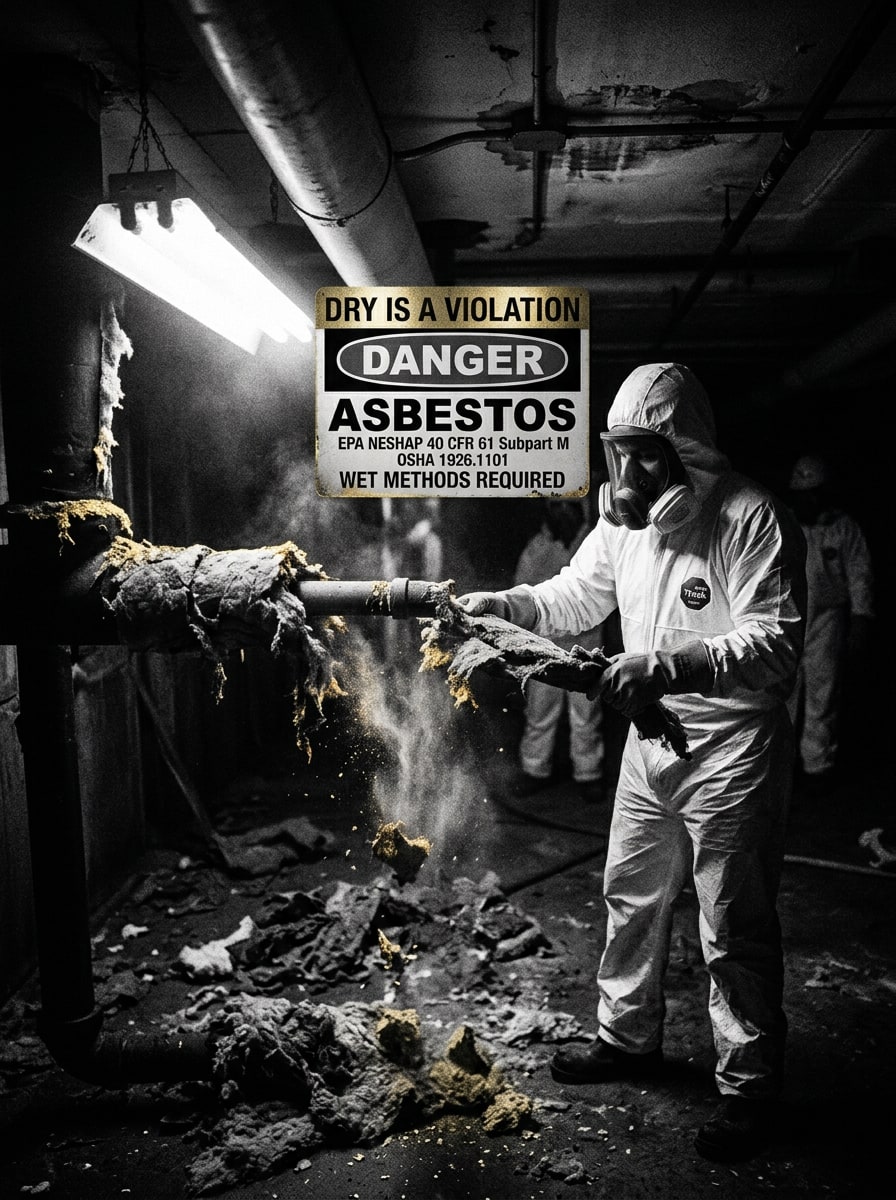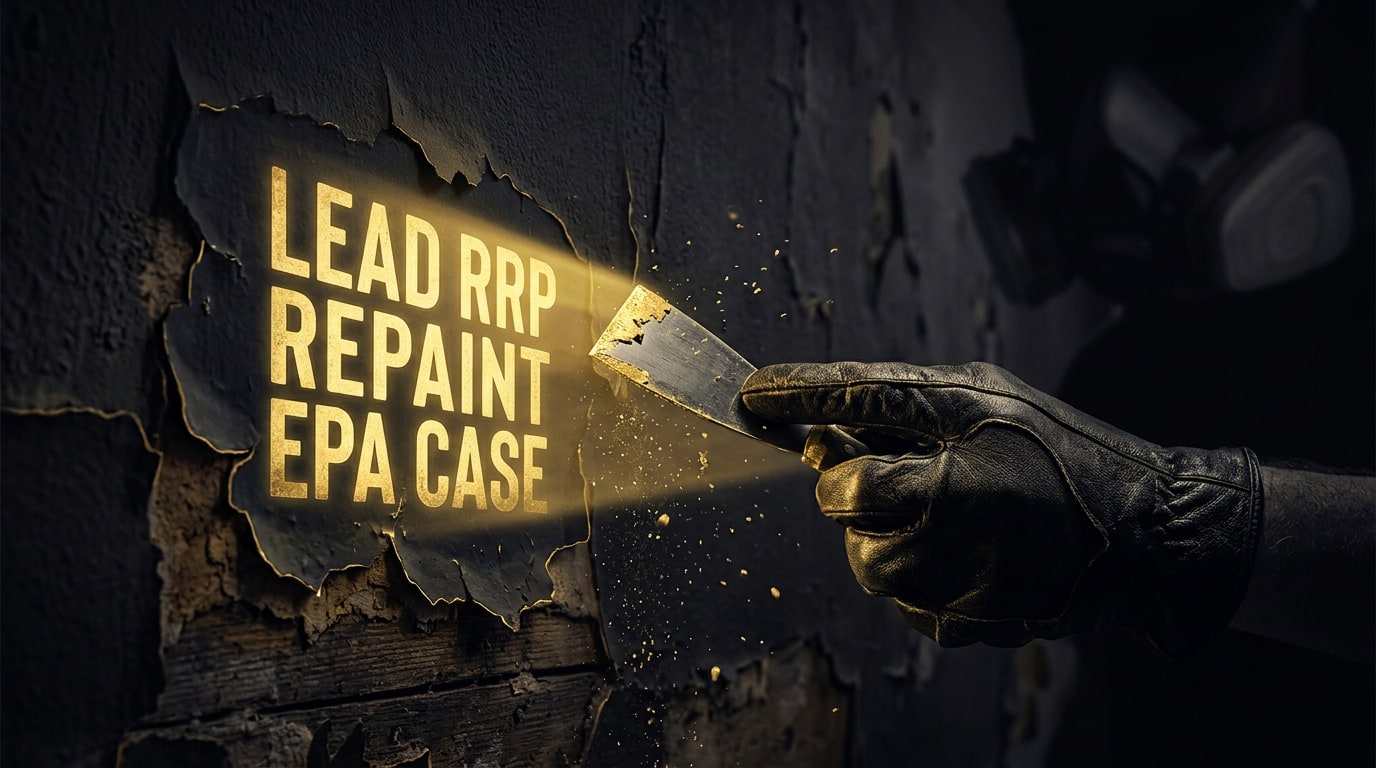
The job looked like a Tuesday. A 1962 office-to-residential conversion, a punch list of repaints, and a crew that had done a hundred of them. They scraped flaking paint off the window casings and door trim, sanded the rough spots smooth, swept up, and moved on. No containment, no HEPA, no test. Just a clean prep and a fresh coat, the way the trade has always done it.
What they actually did was generate lead dust in a pre-1978 building and disperse it through the work area with a broom. The repaint was not a repaint. Under federal rule it was a regulated renovation that disturbed lead-based paint, performed by an uncertified firm, with none of the lead-safe work practices the law requires. The paint job was the easy part. The part that turns into an EPA enforcement case is everything the crew assumed it could skip because the scope said "paint."
The trap is the word renovation. Crews hear "abatement" and think licensed, regulated, paperwork. They hear "repaint" and think routine. The EPA's Renovation, Repair and Painting Rule does not care which word is on the ticket. It cares about one thing: are you disturbing paint in a building old enough to have lead in it.
The 1978 line is the only date that matters
Lead-based paint for residential use was banned in 1978. Any target housing or child-occupied facility built before that year is presumed to contain lead-based paint unless testing proves otherwise. That presumption is the whole regulatory trigger, and it is why the build date of the structure, not the nature of the task, decides which rules apply.
The RRP Rule under 40 CFR Part 745 applies to renovation, repair, and painting that disturbs more than a minimal amount of paint in pre-1978 target housing and child-occupied facilities. The thresholds are small: disturbing more than six square feet of a painted interior surface per room, or more than twenty square feet of exterior, pulls the job into the rule. Window replacement and demolition of painted components are in regardless of area. A crew scraping casings and trim across a few rooms blows past six square feet before lunch.
What the rule actually requires, and what crews skip
The RRP Rule is not a vague gesture at "be careful." It is a specific set of obligations:
- Firm certification. The company performing the work has to be an EPA-certified renovation firm. Not the painter as an individual. The firm.
- A certified renovator on the job. A trained, certified renovator has to direct the work and the lead-safe practices.
- Lead-safe work practices. Contain the work area with plastic, prohibit the practices that generate the most dust (open-flame burning, power sanding or grinding without HEPA attachment, high-heat guns above certain temperatures), and minimize dust at every step.
- HEPA cleanup and a cleaning verification. HEPA vacuuming and wet cleaning, followed by the rule's cleaning verification procedure with the disposable cloths the protocol specifies.
- The paperwork. Provide the EPA lead pamphlet to the owner and occupants, keep records, and document the work for the required retention period.
The broom-and-go crew skipped four of the five. Each omission is independently a violation, and the EPA enforces RRP with civil penalties that run into the tens of thousands of dollars per violation per day, adjusted annually for inflation. The penalty math does not require a poisoned child to trigger. The missing certification and the missing practices are the violation.
OSHA is the second regulator in the room
The RRP Rule protects the building's occupants. The workers doing the scraping are covered by a different standard entirely: OSHA Lead in Construction, 29 CFR 1926.62. That standard sets a permissible exposure limit for airborne lead, requires an exposure assessment when lead-disturbing tasks are performed, and triggers respiratory protection, hygiene facilities, and medical surveillance above the action level.
So the uncertified repaint generates two separate exposures: an EPA exposure for the occupants and an OSHA exposure for the crew. The same scraper that put the firm in EPA's enforcement path also put the workers in an unassessed, unprotected lead exposure under OSHA. One shortcut, two regulators, and the worker protection is the one most likely to be forgotten because the crew has done it bare-handed for years.
Why this is not abstract, and why the dust is the point
Lead is not a legacy curiosity. The CDC is explicit that there is no safe blood lead level in children, that the effects on developing brains are irreversible, and that deteriorating and disturbed lead-based paint in older housing is a primary exposure pathway. The EPA's public guidance frames renovation dust as exactly the mechanism that converts intact paint into a hazard.
That is why the rule fixates on dust. Intact lead paint on a wall is a managed risk. The moment a scraper or a sander turns it into airborne and settled dust, it becomes the exposure pathway the entire regulatory framework exists to prevent. The lead-safe work practices are not bureaucratic friction. They are the difference between removing paint and aerosolizing a neurotoxin in an occupied building.
The supply chain that keeps a repaint a repaint
The uncomfortable truth is that most of these failures are not defiance. They are a crew that did not have the lead-safe setup on the truck and did not want to lose the day waiting on it, so they ran the job the old way and hoped. That is a supply problem dressed as a compliance problem.
Lead-safe work is a stockable kit, and when the kit is on the shelf the temptation to skip it goes away. We stock the lead-safe renovation stack: Critical-Barrier Poly, HEPA Vacuums + Lead-Safe ConsumablesTrimaco / Mastercraft / Sentinel for containment and HEPA cleanup, the verification cloths and cleaning supplies the RRP protocol calls for, and the 3M respiratory protection and PPE that keeps the crew inside OSHA 1926.62. We are a distributor, not a contractor, and we do not hold the certifications for you. We make sure the gear those certified firms need is on the shelf so a pre-1978 ticket does not become a reason to improvise.
Before the scraper touches a wall, ask the build date. If it is before 1978 and paint is going to be disturbed, the job is a regulated renovation, full stop, and the only question left is whether you are equipped to do it lead-safe or about to do it lead-dangerous. One of those is a repaint. The other is an EPA case.
If you run renovation or abatement work on older DFW building stock and want the lead-safe kit standardized across crews for 2026, we should talk.
Sources
- EPA - Renovation, Repair and Painting Program
- eCFR - 40 CFR Part 745 (Lead-Based Paint, RRP Subpart E)
- OSHA - Lead in Construction 29 CFR 1926.62
- EPA - Protect Your Family from Sources of Lead
- EPA - Enforcement of Lead Laws and Regulations
- CDC - Childhood Lead Poisoning Prevention
- CPSC - Ban of Lead-Containing Paint (16 CFR 1303)

DFW-based distributor of restoration, abatement, and environmental supplies. Built to give crews a partner, not a vendor.