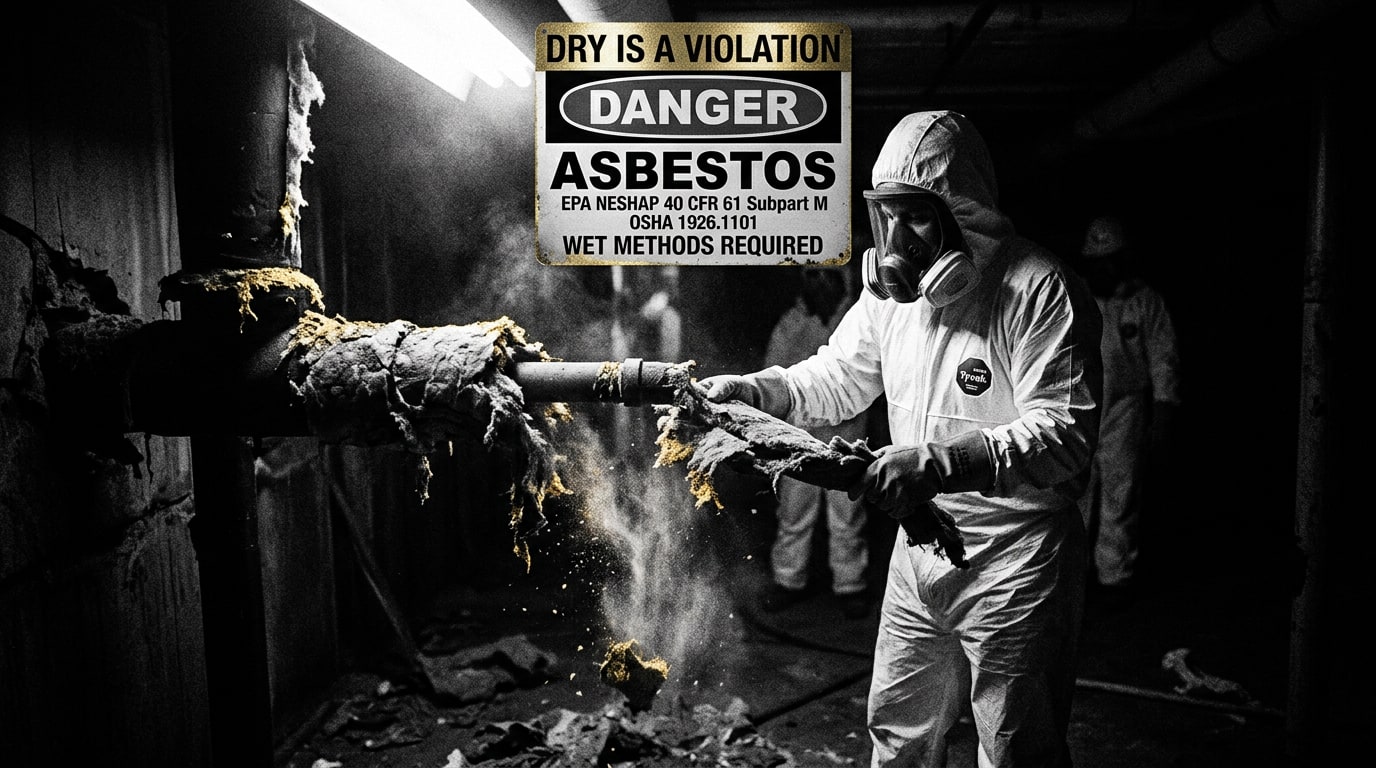
The removal was almost done when the sprayer ran dry. Ninety linear feet of asbestos pipe lag stripped and bagged, the last fifteen feet still on the line, and the amended-water pump-up empty because the job had gone out with one jug of surfactant for a two-jug scope. The lead made the call every rushed crew makes: finish the last run dry, it is only fifteen feet, the bags are already going out. The debris that came off that final section went into the bag with a puff of fiber the whole containment could see in the work lights.
That puff is the entire case. A third-party monitor with a phone, an EPA inspector, a rival contractor with a grievance, any of them captures that image and the job is no longer an abatement. It is a National Emission Standard for Hazardous Air Pollutants violation with a federal penalty schedule attached, and the violation was not the ninety feet done correctly. It was the fifteen feet the supply chain could not keep wet.
Asbestos work is unforgiving in a specific way: the standard is written so that the failure is visible. You do not need a lab to prove a dry-removal violation. You need a witness with functioning eyes.
"Adequately wet" is the standard, not a technique
The single most important phrase in asbestos removal is not "containment" or "negative pressure." It is adequately wet, and it is a defined term in the regulation. Under 40 CFR 61.141, adequately wetted means "sufficiently mixed or penetrated with liquid to prevent the release of particulates." That is the whole game. Regulated asbestos-containing material (RACM) that is not adequately wet during handling is, by definition, releasing fiber, and fiber release is the thing the entire NESHAP framework exists to prevent.
The demolition and renovation standard, 40 CFR 61.145, is explicit and repetitive about it. RACM must be adequately wetted when a component is cut or disjoined. RACM stripped in place must be adequately wetted during the stripping operation. And any RACM or asbestos-contaminated debris that is not removed must be treated as waste and kept adequately wet at all times until disposal. Wet is not a step in the sequence. It is a continuous state the material has to be held in from the moment it is disturbed until it is sealed in a landfill.
The trap: no visible dust is not the same as adequately wet
Here is the asymmetry that catches crews who think they understand the rule. Visible emissions prove the material is not adequately wet. But the absence of visible emissions does not prove it is. The regulation is one-directional on purpose: you can fail the standard invisibly, then fail it visibly the moment the material is bagged, moved, or the poly is opened at the disposal site.
This is why "we didn't see any dust" is not a defense. A surface-misted pipe lag can look controlled on the line and shed fiber the instant it flexes into the bag, because the water never penetrated past the outer skin of the lagging. Adequately wet means saturated through, not damp on top, and getting liquid to penetrate dense, aged, often painted-over insulation is a chemistry problem, not a volume problem.
Amended water is chemistry, not a wetter jug of water
Plain water beads and rolls off asbestos lagging. That is the reason the trade runs amended water, water dosed with a surfactant that drops surface tension so the liquid actually wicks into the material instead of sheeting off it. The surfactant is what turns "sprayed" into "penetrated," and penetration is what the definition of adequately wet is really demanding.
Run out of surfactant and a crew is back to spraying water that sits on the surface, which produces exactly the failure mode in the opening: a pipe that looks wet, sheds dry fiber on handling, and fails the standard at the bag. The decision to under-buy surfactant, made on the purchasing side days before the job, becomes a decision to under-wet on the line, and nobody in the containment calls it that out loud.
OSHA is stacked on top of EPA, and it is a fiber count
NESHAP is the EPA air-emissions layer. Sitting directly on top of it is the OSHA asbestos in construction standard, 29 CFR 1926.1101, which governs worker exposure and sets a permissible exposure limit of 0.1 fiber per cubic centimeter as an 8-hour time-weighted average, with a short-term excursion limit above that. OSHA's standard mandates wet methods, HEPA-filtered local exhaust, negative-pressure enclosures for higher-class work, and the respiratory protection to match.
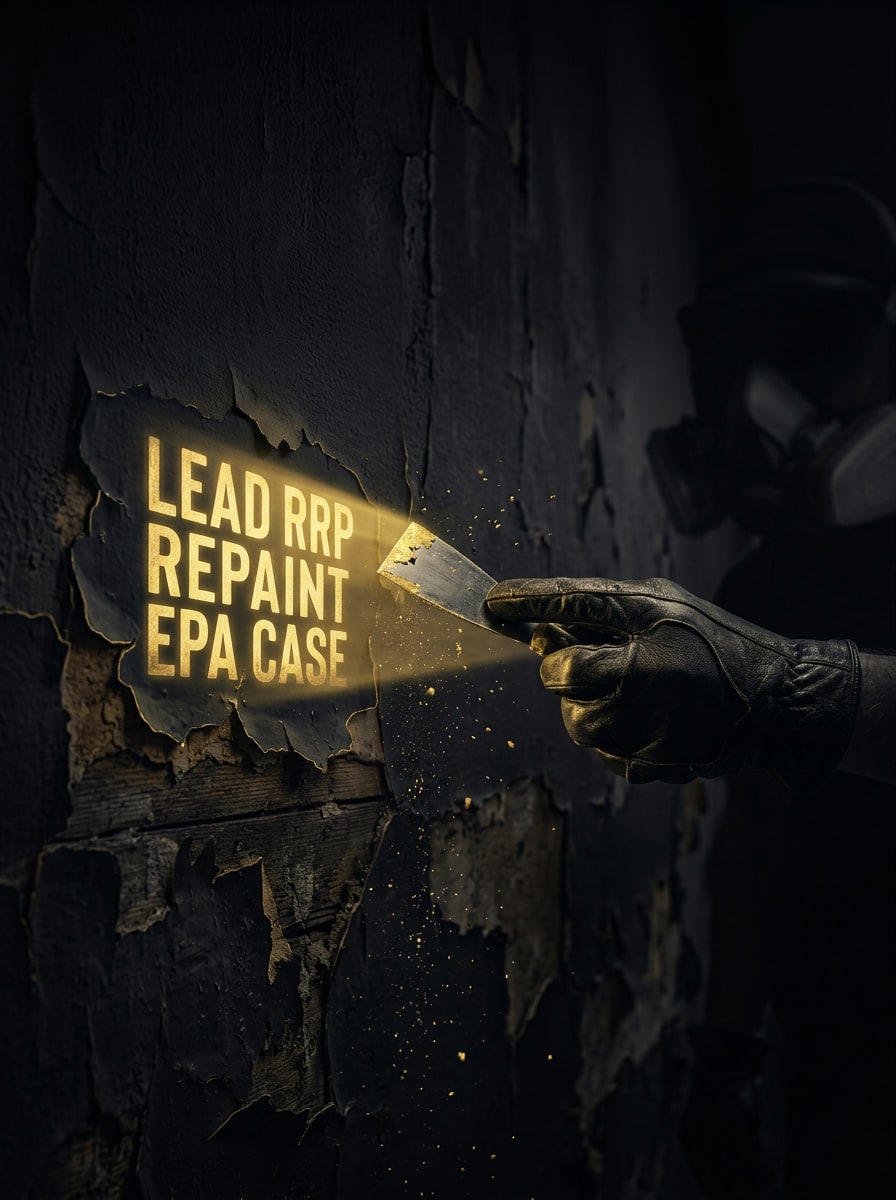
Dry removal detonates both layers at once. It releases the fiber NESHAP prohibits into the air OSHA measures, and it does it in the enclosed volume where the crew is breathing. A dry-stripping shortcut is not a small EPA paperwork problem. It is a simultaneous air-emissions violation and a worker-overexposure event, and the second one has a medical-surveillance tail measured in decades. The same substitution logic that turns a respirator swap into a documentation problem applies here: When PPE Substitution Becomes a Liability Problem. And the regulated-work discipline is the same one a pre-1978 repaint triggers the moment a scraper touches the wall: Pre-1978 and Unprepared.
Wet from the strip to the landfill
The other place jobs quietly fail the standard is between the containment and the dumpster. RACM has to go into leak-tight, labeled containers and stay adequately wet until it is disposed of. That means the poly bags and drums are not a commodity to be bought on price. An underspecified bag that tears, a container that is not leak-tight, or waste that dries out in a hot roll-off before it reaches the landfill are all NESHAP failures that happen after the removal looks finished.
What separates the crews that never generate the photo
After enough abatement reviews, the crews that never hand an inspector a visible-emissions finding share a short list of habits, and most of them are supply decisions before they are field decisions:
- Surfactant is scoped to the job, not rationed on the truck. Amended-water volume is calculated for the linear footage and the density of the material, with margin. Nobody finishes a run dry because a jug ran out.
- Penetration is verified, not assumed. Wet is confirmed through the material, not just on its face, before anything is disturbed.
- HEPA and negative air are running, maintained, and matched to the class of work, so the wet method has a captured-air backstop instead of standing alone.
- The waste stream is specified. Leak-tight, labeled, correctly rated bags and drums, and waste that stays wet until it is gone.
- The chain is bought as a system, because any single weak link is the whole violation.
The supply-side version of a dry-removal citation
A dry-removal violation looks like a discipline problem, and partly it is. Underneath it, almost always, is a supply problem wearing a discipline costume: not enough surfactant to keep the material penetrated, an underspecified disposal bag, a HEPA or negative-air unit that was treated as optional, a wetting agent chosen on price instead of penetration.
That is why we stock asbestos work as a regulated system, not a shelf of parts. Amended Water Surfactant, Encapsulants, and Wetting AgentsFiberlock to keep RACM penetrated from strip to disposal, HEPA-AIRE Negative Air Machines and HEPA FiltersAbatement Technologies for the captured-air backstop, and the labeled 6-mil poly, leak-tight bags, and PPE that carry the waste the rest of the way. Abatement supply is not won by owning the most aggressive scraper. It is won by keeping the material wet enough that there is never a plume to photograph.
Before the next removal goes on the board, ask the one question that decides whether the job is an abatement or a case: is there enough amended water on the truck to keep every foot of RACM penetrated through the last bag, and who verified the surfactant, not just the water? If nobody can answer, the scope was priced for the removal and not for the standard.
If you are scoping abatement work for 2026 and want the wetting agent, the HEPA capture, and the waste stream specified as one compliant system, we should talk. Field reports like this one are how we share what we are seeing across the verticals we serve.
Sources
- EPA, 40 CFR Part 61 Subpart M, National Emission Standard for Asbestos (eCFR)
- 40 CFR 61.145, Standard for demolition and renovation (eCFR)
- 40 CFR 61.141, Definitions, including 'adequately wet' (eCFR)
- EPA, Overview of the Asbestos NESHAP
- OSHA, Asbestos in Construction 29 CFR 1926.1101
- OSHA, Asbestos Safety and Health Topics

DFW-based distributor of restoration, abatement, and environmental supplies. Built to give crews a partner, not a vendor.