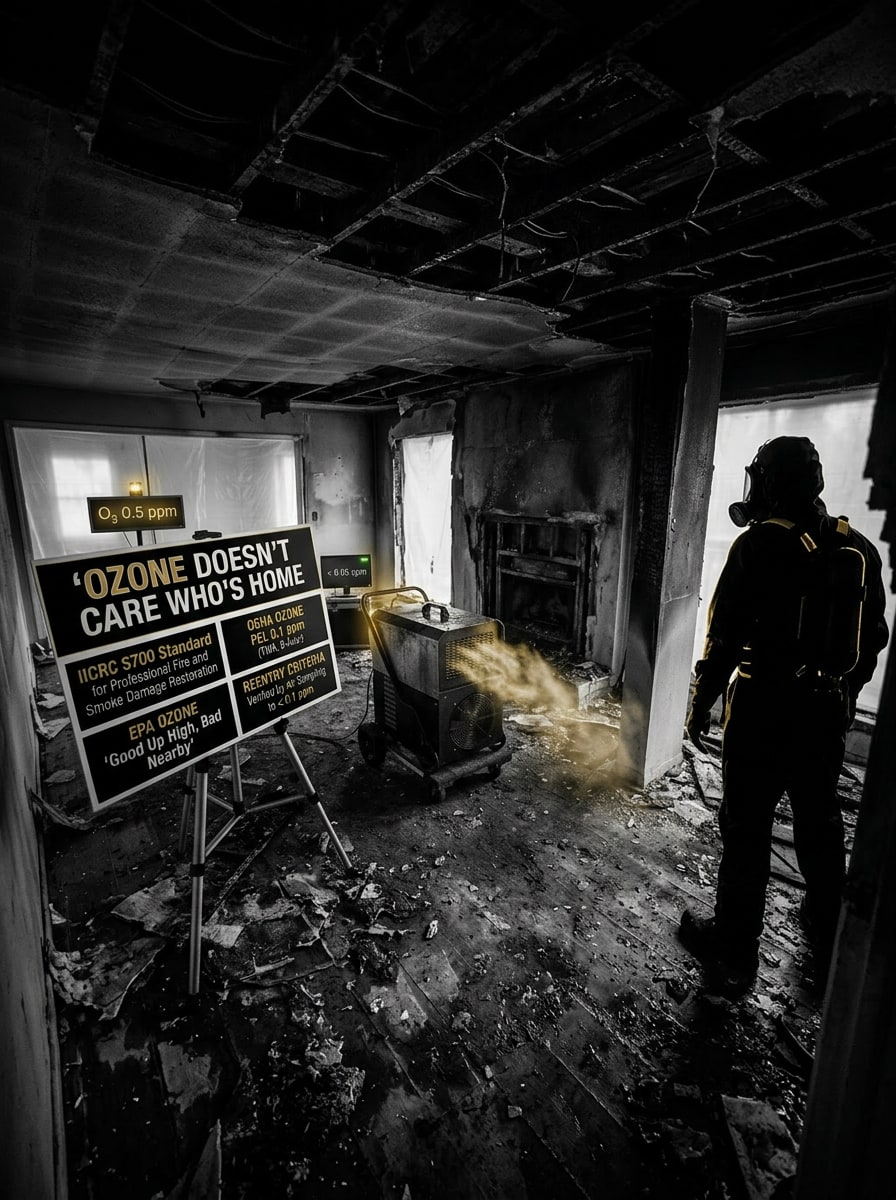
The burn zone looked textbook. Kitchen origin, contained to the first floor, active-fire damage limited to a twelve-foot radius around the range, no structural framing compromised. Crew arrived at 4:20 PM, had plastic up by 5:40, pre-vacuumed with true-HEPA by end of Friday, and by Sunday afternoon had the walls dry-sponge cleaned, ceiling encapsulated, and the affected contents packed out for off-site cleaning. A good job. A closable job.
The call came in eleven days later. The insured was up in the primary bedroom, second floor, other side of the house, no line-of-sight to the kitchen, and every time the HVAC kicked on she smelled smoke. Not faint. Smoke. The kind that makes a homeowner call the carrier and ask whether the restoration contractor actually did the work or just painted over it.
The crew hadn’t missed a square foot. The HVAC had. Or more precisely: nobody had treated the HVAC as part of the burn zone, because on a surface level it wasn’t part of the burn zone. And that’s the miss that sends more fire jobs back to scope than any single other operational failure.
Fire restoration, done right, is a chemistry problem and a physics problem wearing the costume of a cleaning problem. The ANSI/IICRC S700 standard, the consensus document for professional fire and smoke damage restoration, published in 2023 and now the governing reference for the discipline, organizes the work around residue identification, substrate compatibility, and the geometry of how smoke moved through the structure. The burn zone is where the chemistry is worst. But the HVAC is where the chemistry traveled, and it’s where the second complaint call is born.
S700 is a residue-classification standard before it’s a cleaning standard
The most common misread of S700 by junior techs and project managers is to treat it as an equipment-and-method standard, which vacuum, which chemistry, which fogging technique. The standard’s actual framework starts one layer upstream: identify the residue, identify the substrate, then choose the method. Pick the wrong residue classification and the best technique in the world will set the staining deeper.
S700 organizes combustion residues into recognizable categories: dry smoke (high-oxygen, fast-burning synthetics), wet smoke (low-oxygen, smoldering organics, the class that produces the dense, greasy film on cold surfaces), protein residue (the near-invisible film from kitchen fires that carries persistent odor long after the visible damage is gone), fuel-oil soot, and fingerprint soot. The detergency, solvency, pH, and mechanical action required to lift a wet-smoke residue off painted drywall is materially different from what’s required for protein on stainless, and both are different from what’s required for dry smoke on textiles.
The practical consequence for a first-response crew: a pre-clean pass with the wrong chemistry isn’t just ineffective, it’s often counterproductive. Alkaline cleaners on acid-forming residues, solvent-based degreasers on heat-sensitive finishes, water-based chemistry on grimy powder residue that needs to come off dry, each of those is a scope expansion disguised as a cleaning attempt.
Smoke particulate is sub-micron, and HVAC is a distribution system
Here’s the physical fact that dictates the operational reality: a meaningful fraction of smoke particulate, particularly from the synthetic and smoldering fires that produce the worst residue classes, is below one micron in diameter. Fine combustion particles routinely fall in the 0.1 to 2.5 micron range, which puts most of the mass firmly in the PM2.5 regime tracked by EPA indoor-air-quality guidance and characterized in the fire-investigation literature that informs NFPA 921.
Sub-micron behaves differently from anything the eye tracks. It:
- Stays suspended in air for extended periods, especially in low-turbulence spaces like closed bedrooms and behind furniture.
- Migrates easily through any opening the HVAC pulls air across, returns, supply plenums, ductwork seams, the cold-air gap under a closed door.
- Deposits preferentially on cold surfaces (per thermophoresis), which is why windows, exterior walls, and the far side of ductwork often show the residue film even in rooms adjacent to, not part of, the original burn zone.
- Re-aerosolizes the moment ambient humidity drops, HVAC cycles back on, or an occupant disturbs a soft surface. That re-aerosolization is what produces the "it smells again this week" complaint three weeks after a visibly successful cleanup.
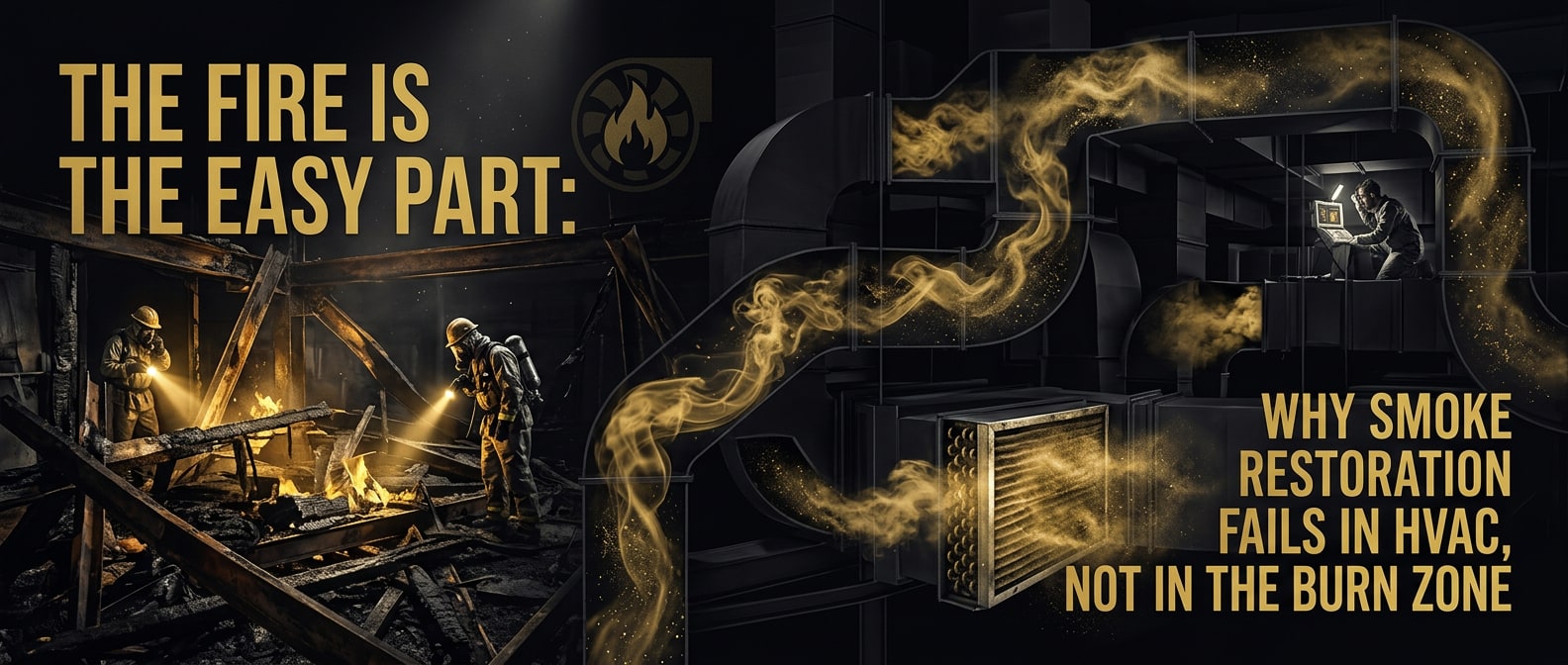
The operational translation: a structure with forced-air HVAC cannot be treated as a single room at a time. The return-side ductwork is a continuous conduit that pulled combustion aerosol through the system from the moment the fire began until the blower was cut. The supply-side ductwork is where that aerosol redeposited, on internal liner, on coil fins, on the inside of supply registers. Every time the system fires after that, it’s a mechanical redistribution of the same residue.
Ignoring the HVAC on a fire job is not an oversight. It’s a physics denial.
True HEPA is a certification, not a marketing word
The filtration spec on the negative-air machines and HEPA vacuums a crew brings to the jobsite is where the job either gets out ahead of the particulate or loses to it. Three filtration tiers are commonly encountered, and only one of them is a defensible standard.
True HEPA is defined with specificity: 99.97% capture of 0.3-micron particles, tested by DOE-STD-3020 or the IEST-RP-CC001 family of recommended practices. The filter carries individual DOP or PAO leak-test certification, the gasket is integrity-tested, and the filter frame is sealed into the housing so that air can only pass through the media. A true-HEPA vacuum or negative-air machine produces exhaust air that is cleaner than most of the building it’s operating in.
"HEPA-type" and "HEPA-style" carry no performance guarantee. The filter media may meet the 99.97% / 0.3-micron number in isolation, but the housing is almost always leaking at the gasket, bypassing at the motor, or both. In a smoke environment, the leaked particulate is exactly the fraction that goes back into the HVAC and produces the two-weeks-later phone call.
Shop vacuums with "HEPA filters" sold through mass-retail channels are a third category entirely. They rarely carry DOE or IEST certification, their gaskets are consumer-grade, and their stated capture efficiency is often measured on a single-pass basis against the filter media rather than the whole unit. They have a place in dust-dominant construction work. They do not have a place on a fire residue job.
The filtration decision isn’t a price decision. It’s a scope decision. A crew that shows up with sub-HEPA equipment on a structural fire is not starting the job, it’s re-distributing the residue while appearing to clean it.
Thermal fog and ULV fog are not interchangeable
Odor remediation on a fire job is where the chemistry meets the penetration geometry, and it’s the other place the HVAC consideration reasserts itself. Two fogging approaches dominate the field, and they do different jobs.
Thermal fogging heats a petroleum-based or water-based deodorant carrier to near-vaporization, producing a droplet size in the low single-digit-micron range. That droplet geometry approximates, intentionally, the size of the original combustion particulate, which means it penetrates into the same porous substrates the smoke penetrated: drywall, framing, insulation, carpet backing, upholstery padding, and critically, the porous interior of HVAC ductwork insulation. S700 identifies thermal fogging as the structural-deodorization method precisely for this substrate-penetration reason.
ULV (ultra-low-volume) fogging uses a cold-application sprayer to produce larger droplets, typically in the 15 to 60 micron range depending on nozzle. Those droplets settle onto surfaces rather than penetrating into substrates. ULV is the correct choice for contents deodorization, for hard-surface knock-down on odor molecules that haven’t had time to penetrate, and for EPA-registered disinfectant application where the chemistry’s label directions specify cold fogging.
Many fire jobs call for both, in sequence. What most jobs call for, and what relatively few crews actually execute, is a thermal fog of the HVAC system itself, performed after duct cleaning, with the system running so that the fog follows the original migration path of the smoke. That is the single operational step that correlates most strongly with the absence of the two-week complaint call.
OSHA 1910.134 makes a written program non-optional
Every structural fire job that uses respirators, which is to say, every structural fire job, sits under the OSHA Respiratory Protection Standard 29 CFR 1910.134. The standard is not a guideline and it is not aspirational. It requires a written program, a program administrator, medical evaluation of each employee required to wear a respirator, fit testing (qualitative or quantitative) with the same make, model, and size to be worn, training on use and limitations, and cartridge change-out schedules based on exposure assessment.
For fire-residue work, the common specification is a half-mask or full-face elastomeric respirator with P100 particulate filters (magenta color-coded per NIOSH), paired with organic-vapor cartridges when solvent-based cleaning chemistry or encapsulants are in use. Disposable N95s are not adequate for structural smoke work: the fit factor is lower, the filter efficiency is lower, and the filter can only be used once if disturbed.
The places fire crews quietly fail the 1910.134 audit tend to be predictable: no written program, no up-to-date medical clearances, fit-testing done on a different respirator than what’s worn on the job, cartridge change-outs scheduled by calendar rather than exposure, and PPE substituted on the jobsite because the right size wasn’t on the truck. The last one is a supply-chain failure, and it’s the one that Stampede sees show up on the loss-event reviews more than any single other PPE issue.
What separates crews that close clean
After enough post-job reviews on fire losses, a consistent pattern emerges on the clean closes:
-
Residue classification happens before the first chemistry touches a substrate. The crew identifies the residue class in the first walk-through, matches detergency/solvency/pH to substrate before anyone opens a bottle, and pre-tests in an inconspicuous location when the classification is ambiguous. S700 calls this out explicitly, and it is the single discipline that separates crews that clean from crews that redistribute.
-
HVAC is part of the scope, not an upsell. The duct cleaning, coil cleaning, plenum wipe-down, and post-clean thermal fog of the mechanical system are line items on the initial SOW, not a conversation that happens after the homeowner calls back. Carriers know which contractors scope the HVAC and which don’t.
-
Filtration is certified, not assumed. Every HEPA unit on the truck carries a current DOE or IEST certificate, the filter dates are tracked, and the pre-filters are replaced before they load up rather than after. A negative-air machine with a loaded pre-filter is operating at a fraction of its rated CFM, which means the achievable air changes per hour are lower than the project schedule assumed.
-
Thermal fog follows the smoke. Structural deodorization is done with the HVAC running, windows closed, and the fog introduced at the return side so it follows the original migration path. ULV is reserved for contents and hard-surface knock-down.
-
Respiratory protection is programmatic, not improvised. The 1910.134 paperwork, medical clearances, fit tests, and cartridge schedules exist and are current on every tech on the truck. The PPE is in the right sizes, in date, and stocked at the depth the job call-out volume demands.
Items 1, 2, and 4 are training-and-scoping decisions. Item 3 is a capital and certification decision. Item 5 is a program decision that shows up on-site as a supply-chain decision: when the right respirator in the right size with the right cartridge is on the shelf at the distributor, at the volume the crew consumes, the program runs. When it isn’t, the crew substitutes, and the substitution is what loses the 1910.134 audit.
The call that came back was a supply-chain conversation
The eleven-day callback on the kitchen fire had a clear cause the moment the contractor pulled a supply register in the primary bedroom: visible residue film on the far side of the boot, continuing into the duct. The HVAC had been on during the fire, the system had pulled combustion aerosol through the return, and the supply side had redeposited it room by room.
The SOW hadn’t excluded the HVAC. It just hadn’t included it, which in restoration is operationally the same thing. The re-scope added a duct cleaning, a coil wipe, a plenum clean, and a thermal-fog pass through the whole mechanical system with the blower running. A week of additional labor, a carrier conversation, and a margin hit that was entirely preventable at the first walk-through.
The clean part of that job had been textbook. The chemistry part had been textbook. The missing piece was the physics, the fact that HVAC in a forced-air structure is a distribution system for sub-micron particulate, and that anything short of treating it as part of the burn zone is a call-back waiting on a thermostat cycle.
When the storm hits, your supply chain shouldn’t break.
That’s the framing we’ve held on the distribution side from the start: stock the filtration at the certification tier crews actually need (true HEPA, DOE- or IEST-traceable), keep the thermal-fogging equipment and compatible deodorant chemistries on the shelf instead of on a backorder, and keep the PPE, the 3M elastomerics, the P100s, the organic-vapor combination cartridges, in the sizes and volumes a fire crew actually consumes on structural fire work. The crew decides how to scope the job. The distributor decides whether the equipment and the chemistry show up in time to execute the scope without substitutions.
If you’re rebuilding your fire-response stack for 2026, or you’re tired of the HVAC step showing up on scope revision instead of the original SOW, we should talk. Field reports like this one are how we share what we’re seeing across the verticals we serve. New ones will land here regularly.
The call-back is not the audit. The scope is.
Sources
- ANSI/IICRC S700: Standard for Professional Fire and Smoke Damage Restoration
- OSHA Respiratory Protection Standard: 29 CFR 1910.134
- DOE-STD-3020-2015: Specification for HEPA Filters Used by DOE Contractors
- IEST-RP-CC001: HEPA and ULPA Filters
- NFPA 921: Guide for Fire and Explosion Investigations
- EPA, Introduction to Indoor Air Quality
- ASHRAE Standard 62.1, Ventilation for Acceptable Indoor Air Quality
- NIOSH, Particulate Matter and Respirator Protection

DFW-based distributor of restoration, abatement, and environmental supplies. Built to give crews a partner, not a vendor.