The smoke odor in the fire unit was gone by morning, and that was the problem. The crew had set two high-output ozone generators in the burned apartment overnight, doors closed, machines on timers, and come back to a space that smelled scrubbed. What they had not accounted for was the building: a garden-style fourplex on a shared return-air plenum, with tenants still living in the three units the fire never touched. Ozone does not stay in the room you set it in. It followed the ductwork, and by 7 AM the neighbor two doors down was calling the property manager about a chemical smell and a headache that would not quit.
The odor complaint that started the job was a nuisance. The exposure complaint that ended it was a regulatory event, with a chemical the EPA and OSHA both classify as a respiratory hazard migrating into occupied living space. The crew did not deodorize the building. It gassed it, and then had to explain why.
This is the trap in smoke deodorization that has nothing to do with how good the technician is. It is a method-and-equipment decision, made before the machine is ever set, and getting it wrong does not leave you with a lingering odor. It leaves you with a second hazard you created on purpose.
Ozone is not a deodorizer. It is an oxidizer you cannot breathe.
Ozone works. That is the part that gets crews in trouble. It is a powerful oxidizer that genuinely destroys many odor-causing compounds by reacting with them, which is why it has a place in fire and smoke work. But the mechanism that makes it effective is the same mechanism that makes it dangerous: it oxidizes lung tissue exactly the way it oxidizes a smoke molecule. It cannot tell the difference.
The EPA's assessment of ozone generators is blunt about the consequence. For ozone to be effective at destroying odors and contaminants, it has to be present at concentrations far above the levels that are safe to breathe. At concentrations that are safe to breathe, it is not an effective air cleaner. Those two facts together mean there is no overlap window. You cannot run ozone at a dose that deodorizes and is safe to occupy at the same time. One excludes the other.
OSHA and NIOSH already put the numbers on it
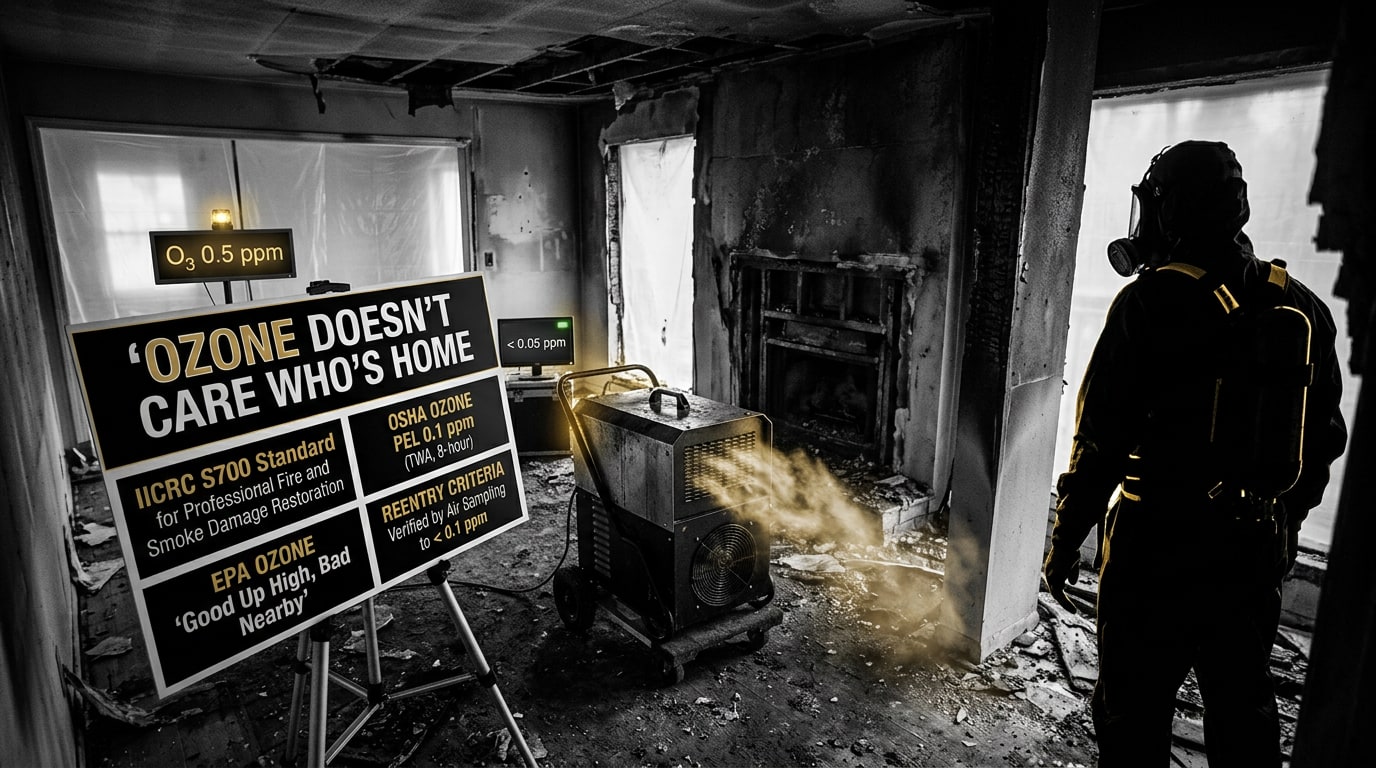
This is not a judgment call the industry gets to make on feel. The exposure limits are published. OSHA's air contaminants standard, 29 CFR 1910.1000, sets a permissible exposure limit for ozone of 0.1 ppm as an 8-hour time-weighted average. The NIOSH Pocket Guide lists ozone as immediately dangerous to life or health at 5 ppm. The effective deodorization concentration a crew is chasing lives far above the first number and marches toward the second.
Put those numbers next to the method and the risk snaps into focus. Running ozone is not "turning on a deodorizer." It is deliberately raising a regulated respiratory hazard to a concentration that would cite you instantly if a worker were standing in it, in a structure you then have to prove is fully evacuated, sealed, and aired back down below the exposure limit before a single person walks back in. California's Air Resources Board went far enough to restrict ozone-emitting air cleaners outright. The hazard is not theoretical.
"Occupied" includes the unit you forgot about
The opening failure was not that the crew ran ozone. It was that they ran it as if the burned apartment were an island. Isolation is the entire discipline of ozone treatment, and it is where jobs quietly go wrong:
- Shared HVAC and return plenums carry ozone straight into adjacent units, common corridors, and floors above. If the system is not fully isolated and shut down, the treatment room is the whole building.
- Unsealed penetrations, plumbing chases, outlet boxes, dropped ceilings, and gaps around ductwork give ozone a migration path you did not plan.
- Re-occupancy timing is a measurement, not a guess. The structure has to be aired out and verified back under the exposure limit before anyone re-enters, and "it doesn't smell like ozone anymore" is not a measurement.
An ozone treatment done right looks less like setting a machine and more like a containment job: the structure evacuated of people, pets, and plants, HVAC isolated, openings sealed, the space posted and secured against entry, then a deliberate off-gassing and clearance before re-occupancy. If a crew cannot guarantee every one of those, the tool is wrong for the site.
Hydroxyl is the occupied-space tool, and it trades speed for safety
The reason this is a supply decision and not just a safety lecture is that there is a different tool for the occupied case. Hydroxyl generators produce hydroxyl radicals, typically through UV and photocatalysis, that oxidize odor compounds at concentrations low enough that the units are designed and marketed to run in occupied spaces. That is the trade: hydroxyl generally works more slowly than a high dose of ozone, so it asks for more dwell time and more units, but it lets the crew treat a structure where people, or a fire-damaged home the family has not moved out of, are still present.
IICRC S700, the fire and smoke restoration standard, frames deodorization as a set of methods chosen to fit the situation, not a single machine applied to every job. Ozone for the sealed, evacuated structure. Hydroxyl for the occupied or unsealed one. Thermal fog, hydroxyl, and other approaches where they fit. The competent decision is matching the method to the occupancy condition of the specific site, and stocking both so the match is possible.
Deodorization is still downstream of source removal
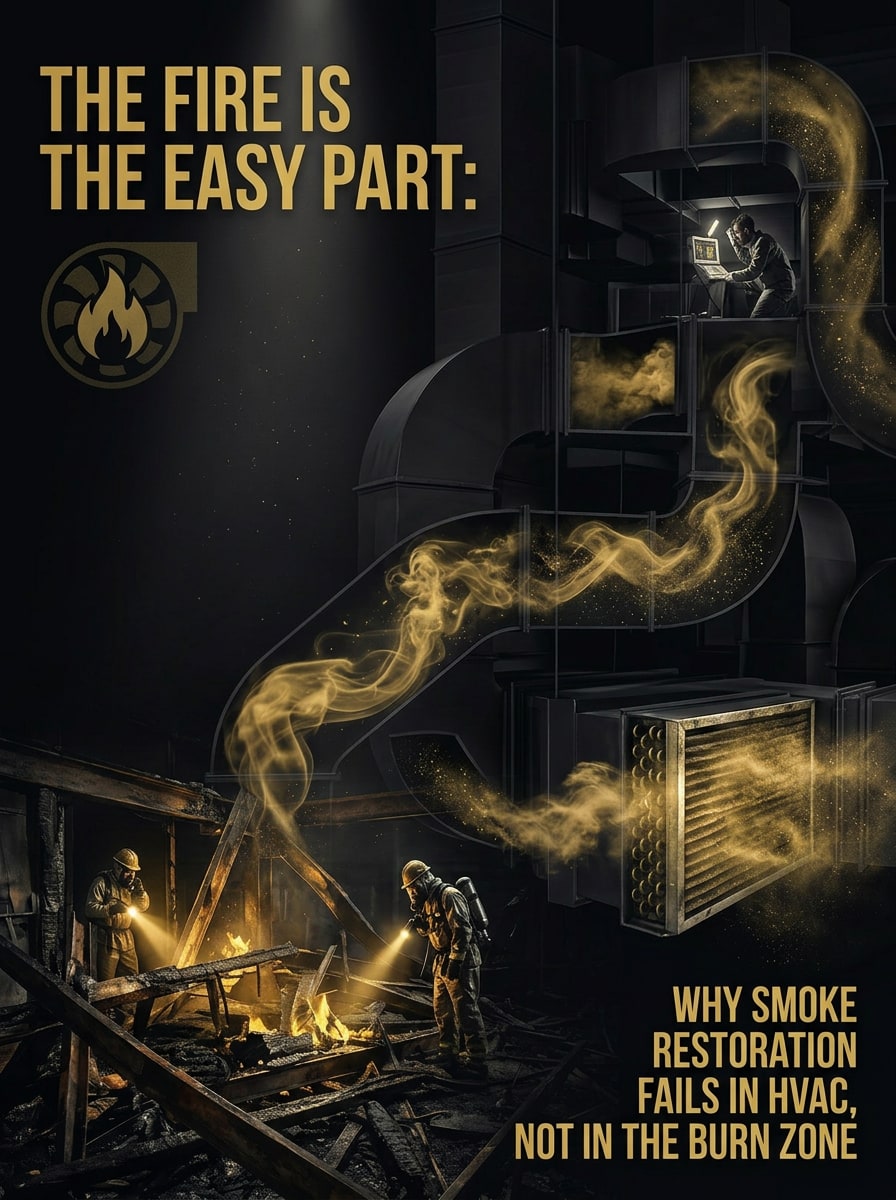
None of this rescues a job that skipped the source. Ozone and hydroxyl both react with odor in the air and on exposed surfaces; neither one reaches into a residue reservoir in a wall cavity or a bed of soot in the HVAC. If the smoke residue is still in the building, the deodorizer knocks the odor down and the reservoir feeds it right back, which is the exact recurrence we broke down in Why Fire Odor Comes Back After the Job Is "Done". And the single largest hidden reservoir is almost always the mechanical system: The Fire Is the Easy Part. Deodorization method is the last step, chosen after source removal, not a substitute for it.
What separates the crews that deodorize without an incident
After enough fire jobs, the crews that never turn a deodorization step into a complaint share a short list of habits, and most of them are equipment decisions made before the machine is set:
- They match the tool to the occupancy. Ozone only for a structure they can fully evacuate, isolate, seal, and clear. Hydroxyl for anything occupied or unsealed.
- They treat ozone like a hazard, because it is one. Full isolation of HVAC, sealed penetrations, posted and secured space, verified re-occupancy, not a timer and a closed door.
- They do the source removal first, so the deodorizer is finishing a clean structure, not masking a dirty one.
- They own both technologies, so the site dictates the method instead of the truck dictating it.
- They verify re-entry with measurement, not with their nose.
The supply-side version of a gassed building
A deodorization exposure incident reads as a technician judgment failure, and partly it is. Underneath it, most of the time, is a supply problem wearing a judgment costume: the shop owned ozone generators and nothing else, so ozone got used on an occupied building because it was the only deodorizer on the truck. The wrong tool got selected because the right tool was never stocked.
That is why we carry fire deodorization as a matched pair, not a single machine. Odorox Hydroxyl Generators for Occupied-Space DeodorizationPyure / HGI for the homes and buildings that are still occupied, alongside ozone units for the sealed, evacuated structures where they are the right call, and Guardian HEPA Air Scrubbers and Negative-Air MachinesPhoenix / Therma-Stor to pull residue and particulate out of the air so the deodorizer is finishing clean. Fire and smoke supply is not won by owning the most powerful oxidizer. It is won by owning the method that fits the building you are standing in.
Before the next deodorization step goes on the schedule, ask the one question that decides whether it is a finish or an incident: is this structure fully evacuated and sealed, or is somebody still living in it, and does the tool on the truck match that answer? If the only deodorizer on the truck is ozone and the building is occupied, the method was chosen by the inventory, not by the site.
If you are building out your fire deodorization capability for 2026 and want ozone and hydroxyl both on the shelf so the site picks the method, we should talk. Field reports like this one are how we share what we are seeing across the verticals we serve.
Sources
- EPA, Ozone Generators That Are Sold as Air Cleaners
- OSHA, Air Contaminants 29 CFR 1910.1000 (Table Z-1, ozone PEL)
- ANSI/IICRC S700: Standard for Professional Fire and Smoke Damage Restoration
- California Air Resources Board, Hazardous Ozone-Generating Air Purifiers
- NIOSH Pocket Guide to Chemical Hazards, Ozone (IDLH 5 ppm)
- EPA, Ozone Generators That Are Sold as Air Cleaners: An Assessment (PDF)

DFW-based distributor of restoration, abatement, and environmental supplies. Built to give crews a partner, not a vendor.