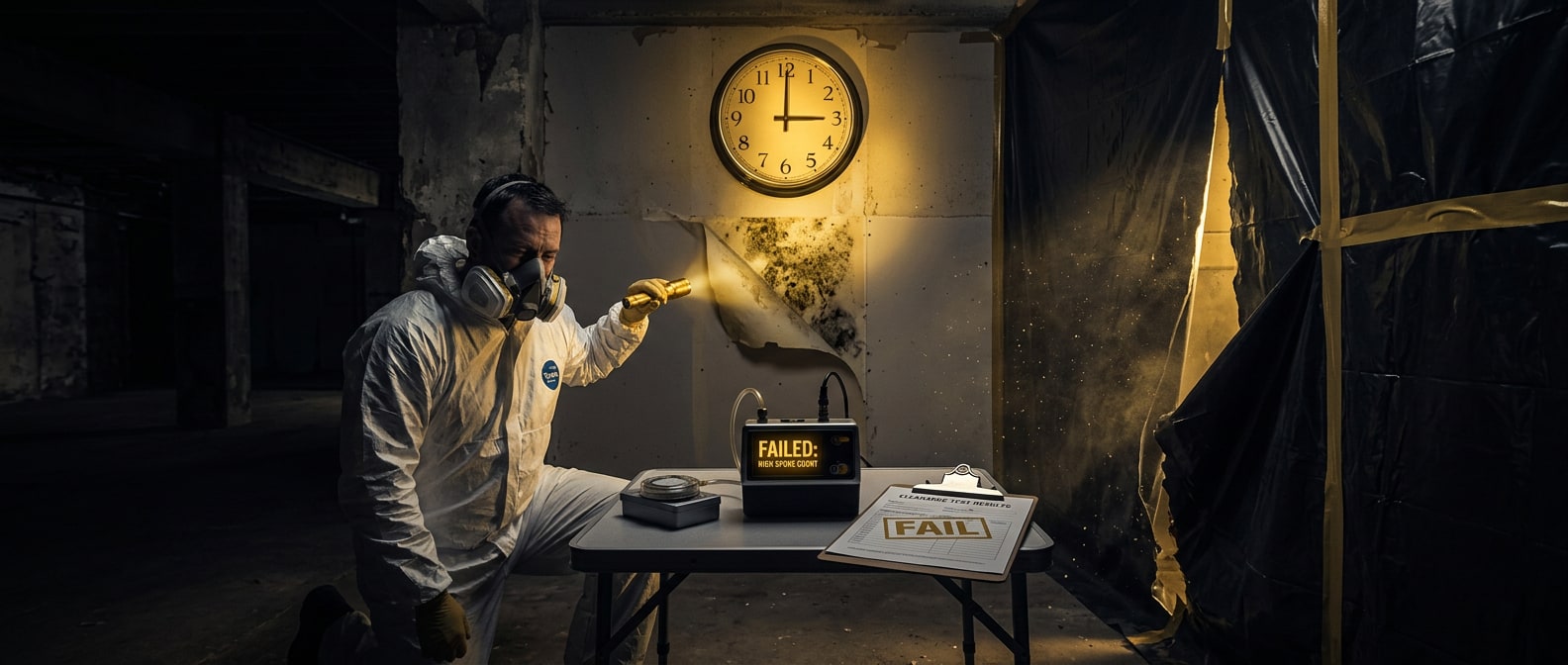
The clearance results came back at 3:07 PM on a Friday. The hygienist had pulled the air samples on Thursday morning, four indoor cassettes, one outdoor baseline, standard protocol. By noon Friday the lab had the spore counts. By 3:07 the PDF was in the PM’s inbox. And by 3:09 the remediation contractor knew the job wasn’t demobilizing Monday.
The indoor cassette from the master bathroom, the primary source area, six days into a Level 3 remediation scoped against visible growth behind a shower surround, showed elevated Stachybotrys counts. Not trace. Elevated, relative to the outdoor baseline and relative to the other three indoor cassettes. The containment had been up the entire time. The negative-air machines had been running the entire time. The HEPA vacuums had been cycled through the work zone for three days. And still the cassette failed.
The next sequence is familiar to every contractor who has lived this call on a Friday afternoon: the carrier’s adjuster wants to know what happened, the insured wants to know why the job isn’t over, the hygienist wants a re-clean and a re-sample scheduled before Monday, and the PM is trying to figure out, in the space of about two hours, whether this is a re-work or a re-scope.
The honest answer, on almost every failed clearance, is that the remediation itself worked. The physics of the remediation didn’t, and the physics is what the clearance test measures. The ANSI/IICRC S520 standard, the consensus document for professional mold remediation, defines the work as three non-negotiable steps: contain the affected area, capture the airborne spores generated during disturbance, and verify the return to Condition 1 (a normal fungal ecology for an indoor environment). Miss any one of the three and the cleaning that happened in between doesn’t matter.
Across enough failed clearances, the failure modes cluster into the same three. Containment breach, inadequate HEPA cycles, and unresolved moisture source. None of them are exotic. All of them are preventable. And all of them are where the crews that consistently pass write the jobs that consistently don’t.
S520 defines the work as three steps, not one
The single most common misreading of mold remediation, by insureds, by new adjusters, and occasionally by crews that came into remediation from adjacent disciplines, is the belief that the work is, fundamentally, a cleaning job. Remove the growth, clean the substrate, encapsulate what can’t be removed, demobilize.
IICRC S520 organizes the scope differently, because the physics demands it. The standard’s framework treats the work zone as a containment problem first, a capture problem second, and a verification problem third, with cleaning happening inside the containment, under active capture, prior to the verification.
The EPA’s guidance on mold remediation in schools and commercial buildings scales containment to remediation size in five levels: small isolated areas (< 10 sq ft, often no containment needed), mid-sized areas (10–100 sq ft, limited containment and engineering controls), large areas (> 100 sq ft and HVAC systems, full containment with negative pressure, HEPA filtration, and decontamination chambers), and HVAC-involved work with special handling. The New York City DOHMH Guidelines, one of the most-cited reference frameworks in the industry, even outside New York, uses a similar condition-based structure.
What both frameworks have in common is the recognition that the work itself generates the contamination the verification measures. Spore disturbance during removal produces an aerosol that, absent engineering controls, migrates through every wall penetration, HVAC return, and door gap in the structure. The cassette the hygienist pulls on clearance day doesn’t measure whether the substrate got clean. It measures whether the containment held while the cleaning was happening.
Failure mode #1: The containment that lost negative pressure for an hour
The first and most common failure mode is a containment breach during active disturbance. The failure rarely looks like the dramatic breach in the training video, a ripped poly seam, an open zipper door, a collapsed critical barrier. Those are visible and usually caught. The operationally costly breach is the one where negative pressure quietly dropped for forty minutes on a Wednesday afternoon because a pre-filter on one of the negative-air machines loaded up and the unit’s effective CFM fell below what was needed to maintain the differential across the containment.
Negative-pressure containment is a math problem before it’s a procedural one. The enclosure volume and the target air-change rate dictate the negative-air CFM the stack needs to produce. The AIHA and the EPA’s commercial guidance both frame the working target around roughly four air changes per hour for typical remediation work, with higher rates for higher-contamination scenarios. That CFM has to be available continuously, with pre-filters fresh enough to pass air at rated flow and with enough total capacity that a single unit going down doesn’t collapse the envelope.
The places crews lose pressure without realizing it are predictable:
- Pre-filters loading faster than the cadence expected. A construction environment, an old HVAC system kicking dust into the containment, or a particularly contaminated source area can cost a pre-filter its working life in hours rather than days. A magnehelic or manometer reading inside the containment tells the story the operator needs to see, and many crews either don’t deploy one or don’t log the reading.
- Under-sized stack because the volume calculation skipped a ceiling cavity. Unfinished attics and open plenum spaces count toward the containment volume; crews that calculate only the finished-floor footprint under-size the negative-air stack by the height of the cavity.
- HVAC left running on zones adjacent to the containment. Even a properly sealed containment can be fighting a pressure imbalance on the wrong side of a sealed wall if the building’s HVAC is pulling return air from a neighboring zone in ways the static pressure model didn’t account for.
- Single-point failure with no redundancy. One machine goes down at 2 AM and nobody catches it until the 7 AM walk-in.
A containment that’s losing 45 minutes of negative pressure during active removal is the physical mechanism behind the elevated Stachybotrys count on the clearance cassette. The cassette doesn’t know when the breach happened. It only knows the spore arrived.
Failure mode #2: HEPA cycles that skipped the second pass
The second failure mode is under-cleaning during the capture phase, and the specific sub-failure is almost always the same: the second HEPA vacuum pass, the one that runs after settling time, on all surfaces within the containment, before the sampling is called, gets compressed or skipped because the job is running behind schedule.
The work sequence inside the containment, in the order S520 and the EPA guidance both reinforce, looks roughly like: source removal, HEPA vacuum pass, wet-wipe or chemical clean, settling time, second HEPA vacuum pass, final wipe, settling time, sampling. The settling time between the final mechanical disturbance and the sampling is what allows airborne spores to fall to horizontal surfaces, where the second HEPA pass can capture them. Skip the pass and those spores either stay airborne for the cassette to see or re-aerosolize when the hygienist opens the containment door.
Two supply-side conditions drive the skipped second pass more often than crews admit:
-
The HEPA vacuum on site isn’t actually HEPA. As with fire restoration, the distinction between a true HEPA unit: 99.97% at 0.3 microns, certificate-traceable, gasket-integrity tested, and a "HEPA-type" or "HEPA-style" shop vacuum is not a marketing distinction. A sub-HEPA unit running a second pass is redistributing spores, not capturing them. The cassette catches this every time.
-
The filters and bags are exhausted. A properly rated HEPA vacuum with a fully loaded pre-filter or bag drops below rated capture well before the visible clog. Crews that don’t carry spare filters and bags in stocking depth end up running the second pass on compromised media, which, on a cassette, reads identically to not running it at all.
The second HEPA pass is also where the chemistry layer matters. Post-vacuum, many crews apply an EPA-registered antimicrobial, Benefect Decon 30, Bioesque Botanical Disinfectant, or one of the quaternary-ammonium or hydrogen-peroxide formulations, as a final surface treatment. The antimicrobial doesn’t substitute for HEPA capture, but it does address the viable-spore fraction on surface, which is particularly relevant when the sampling method includes viable (culture-based) analysis in addition to total-spore counts.
Failure mode #3: The moisture source that was never actually resolved
The third failure mode is the one that makes a contractor want to blame the crew when the real blame lies upstream of the remediation scope entirely: the moisture source driving the colonization was never actually resolved. The remediation cleaned up the visible growth. The water source is still wet. The cassette either catches the new amplification that happened between cleaning and sampling, or the clearance passes and the job comes back in ninety days with visibly re-colonized substrate.
Moisture is, per every major guidance document, the necessary-and-sufficient condition for mold amplification in building interiors. The EPA’s brief guide frames it plainly: control moisture and you control mold. The CDC position is functionally identical. Cleaning without moisture resolution is, at best, a temporary intervention and, at worst, a billable sequence that the insured will learn to distrust the contractor for.
The moisture sources that remediation crews miss, or that the SOW excluded because they were outside the scope of work, tend to be predictable:
- The slab leak behind the affected wall. The remediation addressed the drywall, insulation, and framing. The slab seepage continued at low flow after demobilization. Within weeks, the repaired assembly re-wets from the bottom.
- The HVAC condensate pan overflow. The mechanical system generated the moisture that drove the original growth. Without a condensate-system inspection and repair, the remediation is a resurfacing exercise.
- The building-envelope water intrusion no one tracked to the active entry point. Window head flashings, roof valleys, kick-out flashings, and reverse-lapped housewraps are chronic offenders. The interior growth is downstream of an exterior failure.
- The relative humidity the building can’t control. In hot-humid climates, an HVAC system that can’t maintain interior relative humidity below roughly 60% produces condensation on cold surfaces, and will drive colonization on any porous material that gets or stays cold enough.
Moisture verification is a measurable, documentable step. A Tramex or Protimeter pinless or pin-type reading at the affected assembly, before rebuild, confirms the substrate is at equilibrium with its surroundings. A thermal imager confirms there’s no cold-spot condensation pattern that points to an active leak. A psychrometric reading of the interior confirms the space’s humidity target is achievable by the existing mechanical system.
Skip the verification and the clearance test is running against an active moisture source. That’s the remediation job that fails the cassette without a containment breach and without a cleaning error, because the cassette is measuring amplification that started during the sampling window.
What the documentation trail looks like on a passing job
A mold remediation job that passes clearance the first time has a consistent shape in the paperwork, and the paperwork is what the third-party hygienist and the carrier both read to form their view of the work:
- A pre-remediation scope document that identifies the affected material, the likely moisture source, the target containment level per EPA / S520 framework, and the specific air-change rate and negative-air CFM the containment will be sized against.
- A containment integrity log with daily (or continuous) negative-pressure readings from a magnehelic or manometer, pre-filter change cadence, and any noted incidents.
- A HEPA-equipment log with machine serial numbers, HEPA filter certification dates, pre-filter change-outs, and the specific cycles run inside the containment.
- An antimicrobial application record with product name, EPA registration number, dilution, application method, contact time per label, and SDS reference.
- A moisture verification record, readings at the affected assembly at the point the crew believes equilibrium has been reached, with the meter model and serial recorded.
- A pre-clearance walk-through with the hygienist, where the visible conditions are agreed before the cassette protocol is deployed.
That paperwork trail is the evidence that the engineering controls held, the capture was executed, and the moisture source is resolved. It’s what turns a clearance pass from "the lab got lucky" to "the lab confirmed what the documentation already showed."
The crews that fail clearances consistently tend to have patchy or missing versions of the same logs. The crews that pass, pass with paperwork that makes the lab result redundant.
The 3 PM call was a supply-chain failure, not a remediation failure
The Friday-afternoon clearance fail had a clear cause once the crew pulled the logs: one of the two negative-air machines had been running on a pre-filter that should have been replaced Tuesday, went to Thursday. The pressure dropped enough, for long enough, that spore migration during active disturbance was the likeliest mechanism behind the elevated count in the master bathroom cassette.
The machine wasn’t defective. The operator wasn’t untrained. The job had gone long because the supplemental order for pre-filters, placed Monday afternoon, hadn’t landed until Thursday morning, and the crew had run the existing media past its effective life to keep the schedule. By the time the fresh pre-filters hit the jobsite, the spore load in the containment had already had a productive day.
This is the quiet way remediation jobs lose clearances: not through crew error, not through procedural ignorance, but through supply chain gaps that force operators to run equipment past its effective performance envelope. A pre-filter a day late is a pressure differential half a day short, which is an hour of breach, which is a cassette with elevated counts on Friday afternoon.
When the storm hits, your supply chain shouldn’t break.
That’s why we built the remediation stack at Stampede the way we did: pre-filters and HEPA media stocked at the volume and cadence a running crew actually consumes, containment materials, poly, ZipWall, zipper doors, tape, available the same day the next job starts, antimicrobial chemistries from Bioesque and the ICP Group Benefect family in date and in label compliance, and moisture verification gear from Tramex and Protimeter on the shelf instead of a backorder. Our capabilities page is the operational map of what that looks like on a typical mold remediation call-out. The crew decides how to execute the containment. The distributor decides whether the media, the chemistry, and the verification equipment show up in time for the execution to hold.
If the 3 PM Friday call has happened to you, or you’re rebuilding your remediation ratios for 2026 and tired of the pre-filter cadence being the variable that decides clearance, we should talk. Field reports like this one are how we share what we’re seeing across the verticals we serve. New ones will land here regularly.
The cassette doesn’t lie. The lab doesn’t lie. The only variable on clearance day is whether the engineering controls held, and that gets decided upstream of the remediation, long before the hygienist schedules the sample.
Sources
- ANSI/IICRC S520: Standard for Professional Mold Remediation
- EPA, Mold Remediation in Schools and Commercial Buildings
- EPA, A Brief Guide to Mold, Moisture and Your Home
- NYC DOHMH, Guidelines on Assessment and Remediation of Fungi in Indoor Environments
- CDC, Basic Facts About Mold and Dampness
- AIHA, Recognition, Evaluation, and Control of Indoor Mold
- OSHA, Mold in the Workplace
- DOE-STD-3020-2015: HEPA Filter Specification

DFW-based distributor of restoration, abatement, and environmental supplies. Built to give crews a partner, not a vendor.