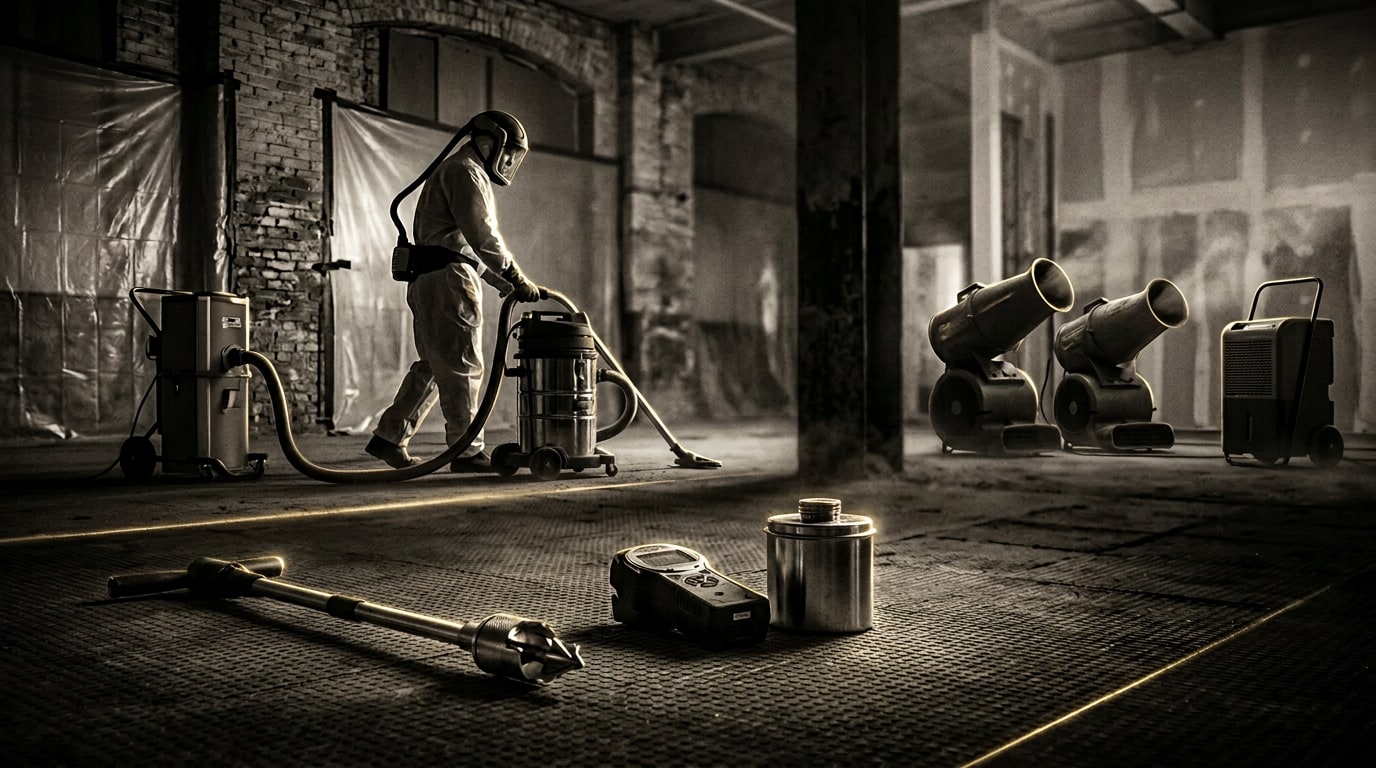
A restoration technician in a hooded suit and respirator vacuuming a stripped commercial interior under containment sheeting, with two air movers, a dehumidifier, an air scrubber, and a moisture meter staged on the floor.

Structural drying

Desiccant vs LGR Dehumidifier

Should this job run a desiccant or an LGR dehumidifier?

The short answer

An LGR condenses moisture on a refrigerated coil. A desiccant adsorbs it onto a rotating drying medium and exhausts it, so its output does not depend on refrigeration and holds up in cold air and at very low humidity targets. Desiccants need ducting and more power. Most structural jobs are LGR work; the exceptions are specific.

Desiccant

Adsorbs moisture onto a rotating medium and exhausts it as wet reactivation air. Not refrigeration-dependent.

LGR

Refrigerant condensation with a pre-cool stage. Self-contained, collects water, no reactivation exhaust.

Desiccant compared with LGR
CriterionDesiccantLGR
PrincipleAdsorption onto a drying mediumCondensation on a cold coil
Cold conditionsLargely unaffectedOutput degrades as temperature drops
Very low humidity targetsReaches lower vapor pressureLimited by the coil
SetupProcess and reactivation ductingPlace, drain, run
Power drawHigherLower
Heat added to spaceSignificantModest
Typical useSpecialty and large-loss dryingRoutine structural drying

Which one this job needs

Desiccant

When the desiccant is the right call

  • Ambient temperature is low enough that refrigerant output is compromised, such as unheated structures in winter.
  • The target is a very low vapor pressure, typically to pull bound water out of hardwood, plaster, or dense assemblies where an LGR has plateaued.
  • The loss is large and open, and one high-capacity unit with ducted distribution is more manageable than a fleet of individual dehumidifiers.
  • The drying environment can accept the added heat and the exhaust run can actually be routed out of the space.
LGR

When the LGR is the right call

  • The structure is conditioned and within the temperature band where refrigerant units perform well, which covers most residential and commercial losses.
  • Setup speed matters. An LGR is placed and drained, with no reactivation exhaust to route through the building envelope.
  • Power at the property is limited, which is a real constraint on occupied buildings and older residential panels.
  • The class of intrusion is 1 through 3 and readings show the assembly responding, so there is no reason to escalate.

What the standard actually says

S500 frames equipment selection around the drying goal and the assembly, not around a product category. Its Class definitions are the practical trigger: Class 4 denotes deeply held or bound water in low-permeance materials and calls for specialty drying methods, which is where desiccant capability usually enters the conversation. Below that, the deciding evidence remains psychrometric readings showing the assembly is trending toward goal.

Stampede is a distributor, not a restoration contractor. The restoration contractor makes the final determination.

We stock both sides

Browse the categories these choices come from, or send a list and a rep will price it. If a maker we carry builds something not published on this site, ask for it by part number: that is a publishing gap, not a supply gap.

Common questions

Does a desiccant dehumidifier need to be vented outside?

It needs its reactivation air routed out of the drying environment, because that stream is what carries the collected moisture away. Exhausting it back into the space you are drying puts the water straight back. Process and reactivation ducting is a real part of the setup and a real part of whether a desiccant is practical on a given property.

Will a desiccant overheat the structure?

It adds meaningful heat, which is sometimes useful and sometimes a problem. On a cold structure the added heat helps. In an occupied or heat-sensitive space it is a constraint that has to be planned for, alongside the higher power draw, before the unit is committed to the job.

Is a desiccant always better than an LGR?

No. For the majority of conditioned structural losses an LGR reaches drying goal with less setup, less power, and no exhaust routing. Desiccants earn their place in cold conditions, at very low humidity targets, and on bound water in dense assemblies. Choosing one by default rather than by condition is how jobs get overbuilt.