The harness passed the walk-through. Inspection tag current, webbing free of cuts, hardware intact, the worker trained and tied off before he stepped to the edge. Every box a superintendent checks on a clipboard was checked. The setup would have passed an audit on the spot.
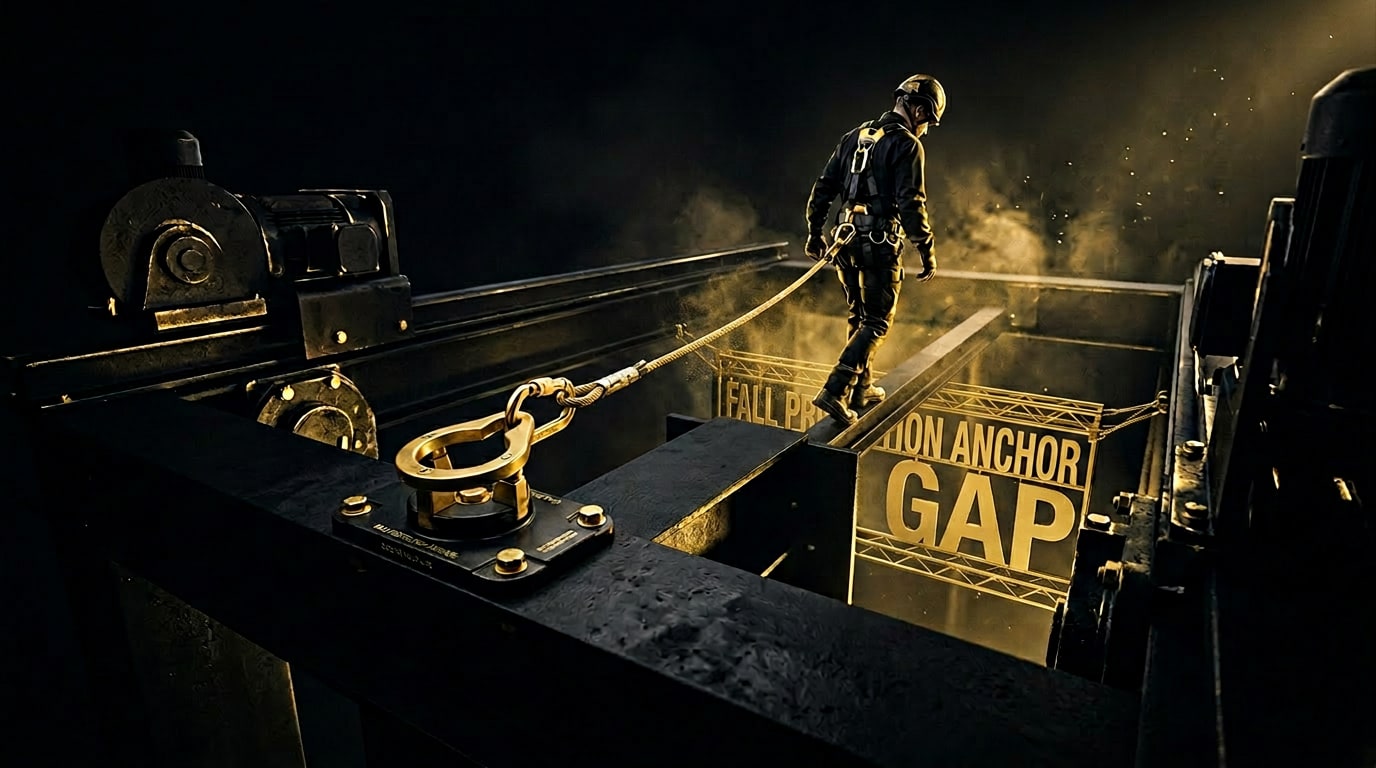
It would not have stopped the fall. The connector was clipped to a piece of conduit strut because it was the closest thing to reach, the lanyard was a six-foot shock-absorbing model on a deck with maybe twelve feet of clearance to the level below, and the math nobody ran said the worker would have bottomed out before the system arrested him. In-date gear, trained worker, and a setup that was decorative.
This is the fall-protection failure that survives inspections: the equipment is compliant and the application is not. OSHA 1926 Subpart M does not give credit for a harness in date. It requires a system that actually arrests the fall, and a system is the harness, plus a rated anchor, plus a connector matched to the available fall clearance. Get any one of the three wrong and the other two are theater.
Subpart M is a system standard, not a gear checklist
The OSHA fall-protection standard for construction generally triggers at six feet above a lower level for most construction work. Once you are over that trigger, the employer owes a fall-protection system, and personal fall arrest is one option among guardrails and safety nets. When the chosen system is personal fall arrest, 29 CFR 1926.502 spells out the criteria, and they are about performance, not possession.
The standard sets hard numbers: a personal fall arrest system has to limit arresting force on the body, bring the worker to a complete stop, limit free fall, and have enough clearance that the worker does not contact a lower level. Those criteria are met by the system as deployed, not by the rating printed on any single component. A harness rated to the standard, clipped to an anchor that is not, in a configuration that lets the worker hit the deck, fails every one of them while every individual part looks fine in a bin. The same logic governs respirable-silica control, where the right blade on an undersized dust extractor still fails OSHA Table 1: Table 1 Says Compliant. Your Silica Dust Says Otherwise..
The anchor is the assumption everyone makes and nobody verifies
The most common field shortcut is tying off to whatever is in reach: conduit, a strut, a small pipe, a piece of decking, a guardrail post never engineered for it. The standard's expectation is unambiguous. An anchorage for personal fall arrest has to be capable of supporting 5,000 pounds per attached worker, or be designed, installed, and used under the supervision of a qualified person as part of a system that maintains a safety factor of at least two.
Five thousand pounds is not a number you eyeball. Conduit strut is not it. A handrail is not it. The anchor either was engineered to hold an arresting load or it was not, and "it looked solid" is the assumption that turns a fall into a fatality when the attachment point lets go and becomes a projectile.
ANSI/ASSP Z359, the consensus fall-protection code that runs alongside the OSHA rule, formalizes anchor strength, connector compatibility, and system design precisely because the field default is to improvise the anchor. The code exists because the anchor is the link people skip.
Fall clearance is the math the lanyard hides
Here is the calculation that almost never gets run on the deck, and the one that decides whether a correctly anchored system actually works. With a six-foot shock-absorbing lanyard, the total fall distance is not six feet. It is the free fall, plus the deceleration distance as the energy absorber deploys, plus the height of the worker below the attachment point, plus a safety margin. Stack those and a six-foot lanyard can need roughly 18 feet of clearance below the working surface before the worker stops.
If the level below is twelve feet down, that system does not arrest the fall. It documents it. This is why a self-retracting lifeline, which limits free fall to a short distance and arrests quickly, is the right connector for low-clearance work, and why grabbing the longest lanyard on the truck is a clearance error waiting to happen.
The connector has to be chosen against the clearance, every time:
- Low clearance below the work surface? A self-retracting lifeline, rated and positioned for the application, not a six-foot lanyard.
- Leading-edge or foot-level anchor work? A connector specifically rated for sharp-edge and foot-level tie-off, because a standard SRL can fail over a sharp edge or in a higher free-fall configuration.
- Anchor above the dorsal D-ring? Always the goal, because overhead anchoring is what keeps free fall and clearance numbers small.
This is the standard that gets cited the most for a reason
Fall protection in construction is, year after year, OSHA's single most frequently cited standard. And falls remain a leading cause of death in construction, a fact NIOSH and OSHA have built sustained prevention campaigns around. The reason the citation count and the fatality count stay high is not that crews refuse to wear harnesses. It is that the system gets assembled wrong: the right harness, the wrong anchor, the wrong connector for the clearance, and a walk-through that only checked the harness.
The cost of getting it wrong is not measured in citation dollars. It is measured in the one fall the decorative system did not stop. But even setting the human cost aside, fall-protection citations carry work stoppages, repeat-violation multipliers, and an insurance conversation that follows the company for years.
The supply-side fix is selling the system, not the harness
The pattern we see is that crews buy harnesses because harnesses are the visible, per-worker item, and they treat anchors and connectors as generic. That is the gap. The fix is specifying the three parts as one system against the actual geometry of the work:
We stock fall protection as the complete arrest system: FallTech Harnesses, SRLs + Rated AnchorsFallTech with the connector selected for the clearance, anchors rated to the 5,000-pound criterion or engineered anchorage components, and the inspection and rescue gear the standard also requires. A rep can match the SRL or lanyard to the fall clearance so the system that passes the walk-through is the same system that stops the fall. Construction supply is about the whole chain, harness to anchor to clearance, not the one piece with the inspection sticker.
In date is a maintenance fact. Anchored, with clearance, is a survival fact. The walk-through checks the first. The fall tests the second. Spec the system so both answers are yes before anyone steps to the edge.
If you are standardizing fall-protection kits across crews for 2026 and want the connector matched to real clearances instead of whatever is in the gang box, we should talk.
Sources

DFW-based distributor of restoration, abatement, and environmental supplies. Built to give crews a partner, not a vendor.