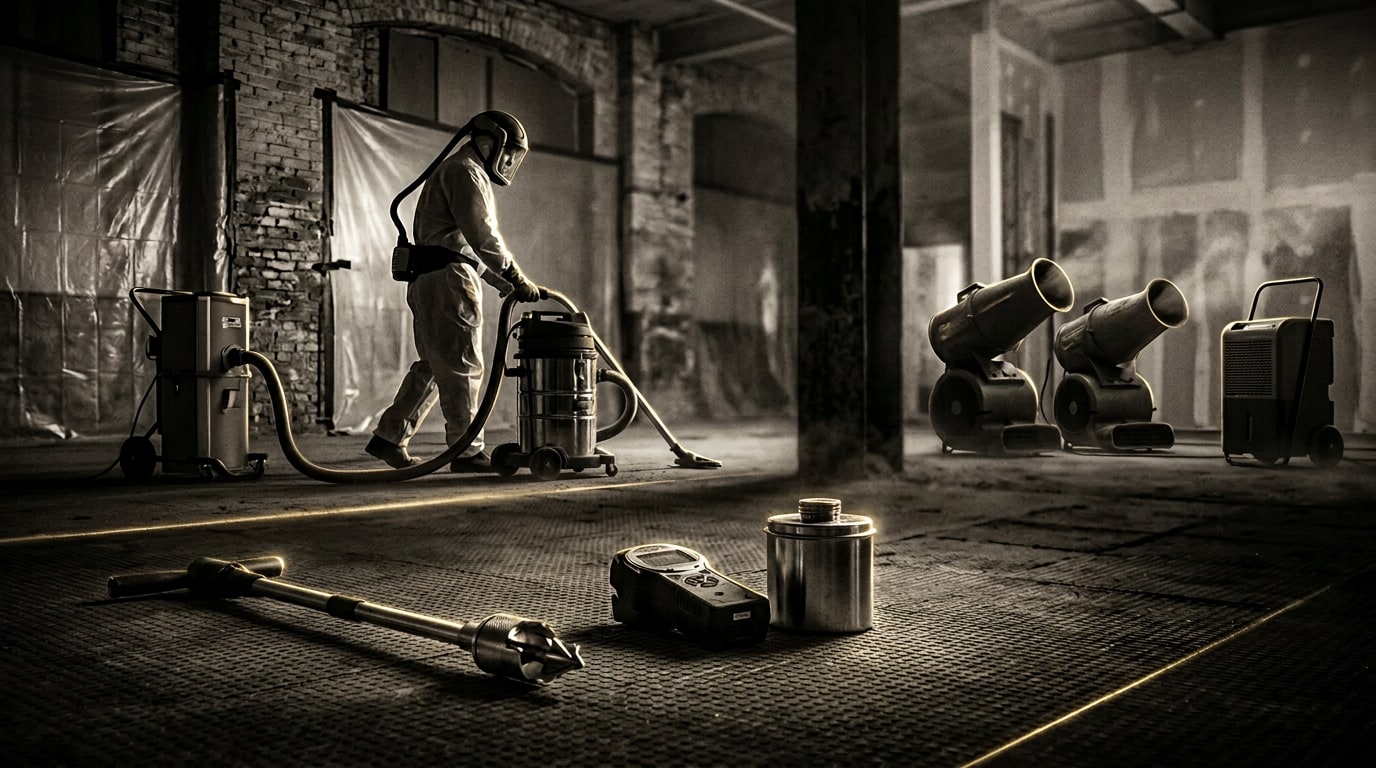
A restoration technician in a hooded suit and respirator vacuuming a stripped commercial interior under containment sheeting, with two air movers, a dehumidifier, an air scrubber, and a moisture meter staged on the floor.

Respiratory protection

P100 vs N95

Is a P100 respirator better than an N95?

The short answer

They are filter ratings, not protection levels. The letter is oil resistance: N is not oil resistant, P is oil proof. The number is efficiency: 95 percent versus 99.97. Actual protection comes from the facepiece class and a verified fit, which is what an assigned protection factor expresses. A poorly fitted P100 protects less than a fitted N95.

P100

At least 99.97 percent efficient, oil proof. Usually a cartridge on a reusable half or full facepiece.

N95

At least 95 percent efficient, not oil resistant. Usually a disposable filtering facepiece.

P100 compared with N95
CriterionP100N95
Filter efficiencyAt least 99.97 percentAt least 95 percent
Oil-containing atmospheresApprovedNot approved
Typical formCartridge on elastomeric facepieceDisposable filtering facepiece
Assigned protection factorSet by facepiece, not filterSet by facepiece, not filter
Fit test requiredYes, when required by the programYes, when required by the program
ReusableFacepiece yes, cartridge replacedNo
Cost per useLower over timeLower up front

Which one this job needs

P100

When P100 is the right call

  • The atmosphere may contain oil aerosols, where an N-series filter is not approved at all and the letter is the deciding factor rather than the number.
  • The hazard is one where a substance-specific standard drives respirator selection, such as asbestos or lead work, and the selection follows that standard rather than preference.
  • Exposure is sustained and repeated, where a reusable facepiece with replaceable cartridges is more economical and more consistently fitted than disposables.
  • A full facepiece is indicated, which also brings eye protection and a higher assigned protection factor than a half mask.
N95

When N95 is appropriate

  • The hazard assessment identifies a non-oil particulate exposure at a level the class covers, and the respiratory protection program documents that selection.
  • Short-duration or intermittent tasks where a disposable is practical and a fit test for the specific model has been completed.
  • Nuisance dust control on tasks that fall outside a substance-specific standard, where an upgrade would not change the exposure math.
  • The program is honest that an N95 is a filtering facepiece, so the assigned protection factor is the low end and the work is scoped to that.

What the standard actually says

OSHA 1910.134 makes selection an output of a written respiratory protection program and a hazard assessment, and requires fit testing before first use and at least annually for tight-fitting respirators. It also publishes assigned protection factors by respirator class: 10 for a half mask air-purifying respirator, 50 for a full facepiece. Note what that means. Moving from N95 to P100 on the same half mask does not raise the assigned protection factor, and a seal broken by facial hair defeats either.

Stampede is a distributor, not an abatement contractor. The abatement contractor makes the final determination.

We stock both sides

Browse the categories these choices come from, or send a list and a rep will price it. If a maker we carry builds something not published on this site, ask for it by part number: that is a publishing gap, not a supply gap.

Common questions

Does a P100 give more protection than an N95?

It filters more efficiently and is approved in oil-containing atmospheres, but protection factor is a property of the facepiece and the fit. A half mask carries an assigned protection factor of 10 whichever filter is on it. Upgrading the filter without changing the facepiece or verifying the seal does not raise the protection the wearer actually gets.

What does the letter in N95, R95 and P100 mean?

It describes performance against oil aerosols. N is not resistant to oil, R is somewhat resistant with limited service time in oil, and P is oil proof. The number is minimum filter efficiency: 95, 99, or 99.97 percent. Both parts matter, and the letter is the one that rules a filter out entirely.

Is a user seal check the same as a fit test?

No. A fit test is a formal protocol confirming a specific make, model, and size seals on a specific person, done before first use and at least annually. A user seal check is the quick verification the wearer performs every time the respirator is donned. The seal check does not substitute for the fit test.