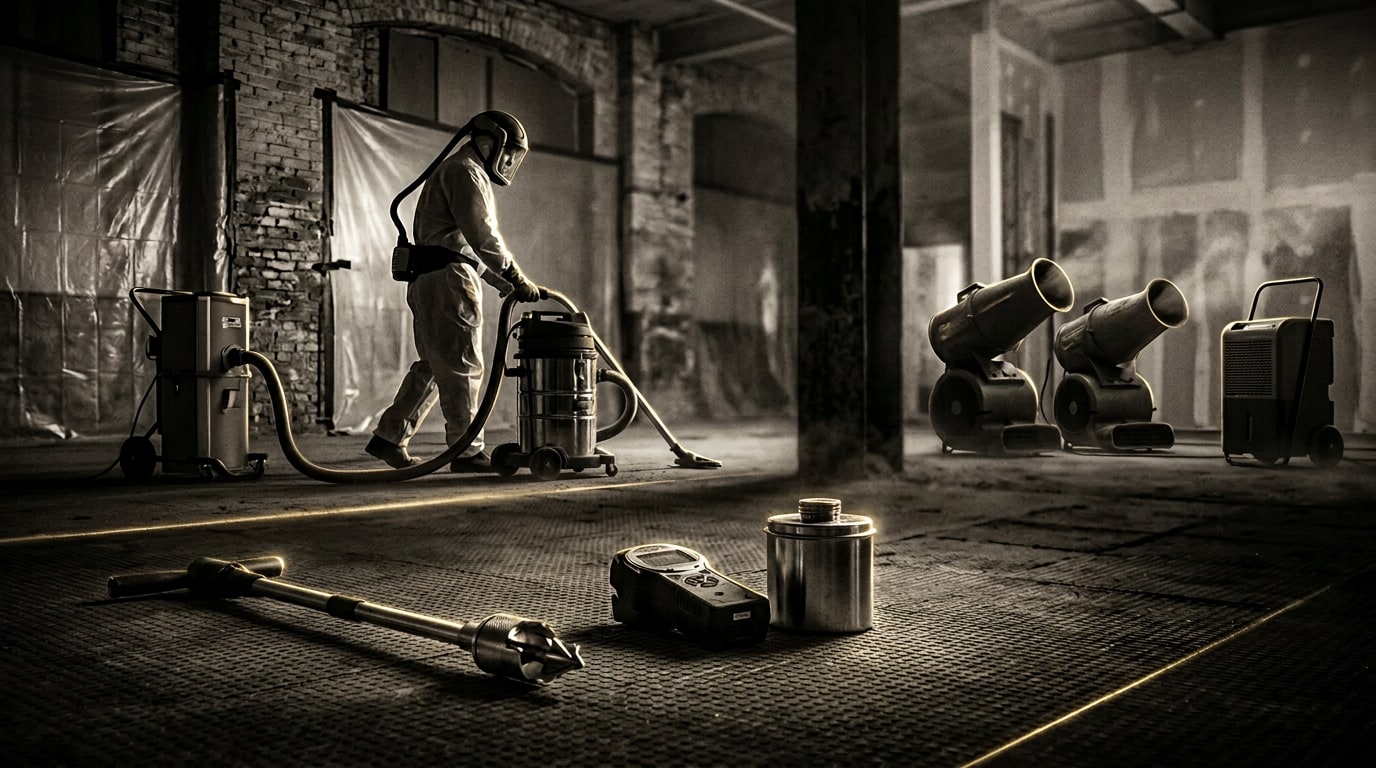
A restoration technician in a hooded suit and respirator vacuuming a stripped commercial interior under containment sheeting, with two air movers, a dehumidifier, an air scrubber, and a moisture meter staged on the floor.

Containment

Negative Air Machine vs Air Scrubber

What is the difference between a negative air machine and an air scrubber?

The short answer

Often the same physical unit. Ducted so it exhausts outside the containment, it pulls the area below surrounding pressure and becomes a negative air machine. Run recirculating inside the space, it lowers particle counts and is an air scrubber. Only the ducted configuration prevents contaminated air from migrating to adjacent areas.

Negative air machine

Ducted to exhaust outside the containment. Establishes and holds a pressure differential.

Air scrubber

Recirculates within the space. Reduces airborne particulate where it sits, no pressure differential.

Negative air machine compared with Air scrubber
CriterionNegative air machineAir scrubber
ConfigurationExhaust ducted out of the areaRecirculating in the area
Creates pressure differentialYesNo
Prevents migration to adjacent spaceYes, while it holdsNo
Reduces particulate in the roomYesYes
Verified byManometer readingParticle counts or visual clearance
Sized byDelivered CFM and enclosure volumeDelivered CFM and enclosure volume
Typical useActive removal under containmentGeneral air cleaning and post-clean

Which one this job needs

Negative air machine

When you need negative pressure

  • Removal or disturbance is happening and contaminated air must not reach occupied or clean areas of the building.
  • The scope of work involves regulated material, where containment integrity is the control the whole job rests on.
  • You can actually route exhaust out of the containment and provide a controlled make-up air path, without which the differential will not hold.
  • Someone is reading a manometer, because containment that is assumed rather than measured is not containment.
Air scrubber

When recirculating filtration is the right tool

  • The goal is lowering airborne particulate in a space that is not under active containment, such as general air cleaning during or after cleanup.
  • Post-remediation, once removal is finished and the objective has shifted from preventing migration to reducing what remains.
  • Exhaust routing is impossible and the work does not require a differential, in which case the honest description of the setup is filtration, not containment.
  • You are supplementing a ducted unit to raise total air changes inside an enclosure that already holds negative.

What the standard actually says

EPA guidance for mold remediation describes containment held under negative pressure relative to surrounding areas, with commonly cited guidance around 0.02 inches of water column as a working minimum. The sizing input is delivered airflow, not the rating plate: a label CFM is measured clean and straight-ducted, and filter loading, duct length, and bends all cut into what the machine actually moves on day three of a job.

Stampede is a distributor, not a remediation contractor. The remediation contractor makes the final determination.

We stock both sides

Browse the categories these choices come from, or send a list and a rep will price it. If a maker we carry builds something not published on this site, ask for it by part number: that is a publishing gap, not a supply gap.

Common questions

Can the same machine be both?

Usually yes. Most units are built to run either ducted or recirculating, and the configuration on the day decides which one you have. Counting machines on site therefore tells you nothing about whether a containment is under negative pressure. The manometer tells you that.

How many air changes per hour do I need?

It is derived from enclosure volume and delivered airflow rather than picked from a table. Calculate the volume, establish true CFM under load with the filters and duct run you actually have, and size to the air change target the scope calls for. Machine count is an output of that arithmetic, never the input.

Why did my containment go positive when a worker opened the door?

Because the system was sized with no margin for the make-up air a door opening admits. A differential that only holds while nobody moves is not a working control. Adequate delivered airflow, a controlled entry, and door discipline are what keep the reading negative during the part of the job that actually generates contamination.